
Introduction
For long stretches of the FIFA World Cup Final, it looked like defense might win it. Spain dominated the ball, Argentina dug in behind a heroic goalkeeper, and neither side found the breakthrough through 90 tense minutes at MetLife Stadium. Then, in the space of about four minutes late in the match, everything changed: a reckless foul, a red card, and — just 39 seconds into the second period of extra time — the goal that decided the tournament.
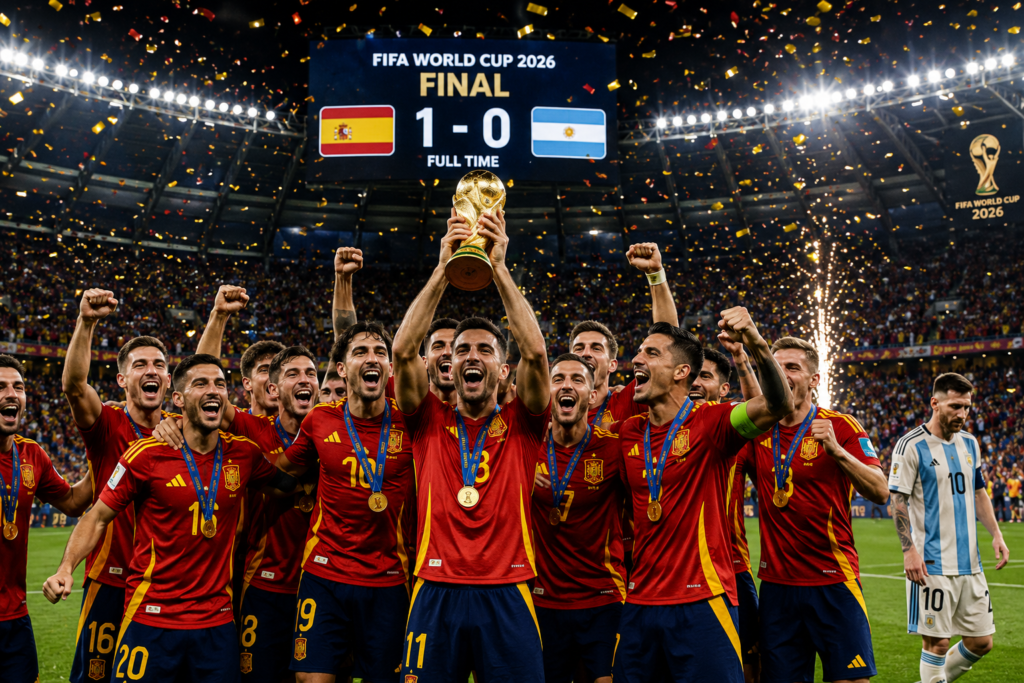
Spain beat Argentina 1-0 to win its second World Cup title, and the result closes the book on one of the more dramatic finals in recent memory. This is the full, verified breakdown of exactly what happened, why the match swung so late, and what it means for both nations moving forward.
Why the Football FIFA World Cup Final Is Trending Today
The reason is straightforward: the final just happened, and it happened in dramatic fashion. Super sub Ferran Torres fired Spain to their second men’s World Cup triumph as what may be Lionel Messi’s last dance ended in Argentina falling to a 1-0 extra-time defeat, with the champions playing a man down for the second half of extra time.
Beyond the result itself, several storylines are driving search interest. Argentina failed to muster a single shot across the first 90 minutes, and only a string of saves from goalkeeper Emiliano Martínez kept the score level that long. Layered on top of the football was the tournament’s closing spectacle. U.S. President Donald Trump attended the match at MetLife Stadium, where the closing ceremony featured heavy American showmanship, including a speech from Tom Cruise and ring announcer Michael Buffer, which delayed kickoff by five minutes.
Match Overview and Final Score
Spain defeated Argentina 1-0 in the Football FIFA World Cup Final, played July 19, 2026, at New York/New Jersey Stadium (MetLife Stadium). Ferran Torres scored the only goal of the match in the 106th minute, deep into extra time.
Spain’s win completes their mission for a second World Cup crown, coming 16 years after their first title, and follows the Spanish women’s national team’s own recent success on the global stage. Luis de la Fuente’s side dominated the final from start to finish but could not find a way past an inspired Emiliano Martínez, who produced several brilliant saves to keep Spain out for most of the match.
Match Timeline
First half — Spain dominates possession and territory, but Argentina’s defense, marshaled by Emiliano Martínez, holds firm without conceding.
82nd minute — Enzo Fernández picks up his first yellow card for protesting a non-call on a challenge from Spain’s Rodri.
Full time (90 minutes) — The match remains scoreless, with Argentina having failed to register a shot in regulation.
90+3′ (second half stoppage time) — Spain appears to take the lead when Nico Williams fires into the net, but the goal is disallowed for a foul on Nicolás Otamendi by Mikel Merino in the buildup.
93rd minute (second half stoppage time) — A collision between Enzo Fernández and Spain’s Pau Cubarsí, in which Fernández runs through an off-balance Cubarsí, draws a second yellow card and a red card from referee Slavko Vinčić.
Extra time begins — Argentina plays the remainder of the match with 10 men.
106th minute (second half of extra time, 39 seconds in) — Substitute Ferran Torres thumps in an eight-yard shot to give Spain a 1-0 lead.
Full time (after extra time) — Spain wins 1-0, securing the World Cup title.
Winning Team: Spain
Spain’s triumph caps a tournament in which the eventual champions started slowly before building into the competition’s most dominant side. Spain began their World Cup campaign with a draw against tournament debutants Cape Verde before going on to become worthy winners of the tournament. Spain finished the final with an expected goals total of 1.94 from 20 shots, an overwhelming advantage over Argentina’s tally of 0.20 expected goals from just two attempts.
Losing Team: Argentina
For Argentina, the final represented a missed opportunity at a historic achievement. Argentina had entered the tournament attempting to become the first team to win four straight major tournaments, having already claimed the Copa América in 2021 and 2024 around their 2022 World Cup title. Instead, the defending champions’ bid for back-to-back World Cup titles ended in defeat, with a performance far below the standard that carried them to the final.
Goal Scorer and Assist
Barcelona forward Ferran Torres, introduced as a 62nd-minute substitute for Mikel Oyarzabal, scored Spain’s winning goal in the 106th minute — his first goal of the tournament. FIFA’s official match record credits Torres with the goal and lists Enzo Fernández separately in connection with the 90+3′ minute mark tied to the red card incident.
Match Statistics
According to FIFA’s official statistics, Spain controlled the match from start to finish. Spain held 60% possession to Argentina’s 32%, with 8% of the ball in contest. Spain registered 20 total attempts on goal to Argentina’s two, with 12 shots on target compared to zero for Argentina. Argentina did not register its first shot of the match until the second half of extra time, while Emiliano Martínez was forced into a World Cup final record 11 saves.
Best Player of the Match
While Torres scored the decisive goal, Argentina’s goalkeeper drew widespread praise for keeping the scoreline as close as it was. Only Emiliano Martínez’s heroics kept Spain at bay for most of the match, with the goalkeeper preventing teenager Lamine Yamal from scoring what would have been a match-winning free-kick. Torres, for his part, earned recognition for delivering the goal that ultimately decided the title in Spain’s favor.

The Enzo Fernández Red Card
The dismissal proved to be the match’s pivotal moment. Fernández had already picked up his first yellow card in the 82nd minute for protesting the lack of a foul call on a challenge from Spain’s Rodri. His second yellow, and resulting red, came in the 93rd minute after he ran through an off-balance Pau Cubarsí following a headed clearance, sending the Spanish defender flipping into the air.
The ejection left Argentina to play the entirety of extra time with 10 men, a disadvantage that Spain ultimately capitalized on when Torres scored less than a minute into the second period of extra time.
Coach Reactions
Argentina manager Lionel Scaloni offered a candid, emotional assessment of both the defeat and his squad’s condition heading into the match. “We had many setbacks with injuries in key positions that we weren’t expecting,” Scaloni said. “We had to substitute three of our four defenders.” He also addressed the red card directly. “Enzo’s sending-off, I think the referee could have avoided giving him that first yellow card, but well, it is what it is,” Scaloni said. “It’s a final, there are things that could have been avoided, but it’s over now.”
The Argentina coach grew visibly emotional discussing what is likely Messi’s final World Cup appearance. Scaloni’s press conference ended abruptly when he walked out in tears while discussing Messi’s legacy, underscoring the weight of the moment for a coaching staff that had led Argentina through three major title runs together.
Player Reactions
Spain’s match-winner described the goal in simple terms afterward. “Honestly, I can’t believe it,” Torres said. “I just try to enjoy but I don’t know what’s happening.” “The goal belonged to 47 million people,” Torres added. “It wasn’t just mine or the 26 players. Destiny was written, and it was meant for us to win far away from our people.”
The final whistle brought tension rather than celebration on the Argentine side. Tempers flared after the final whistle, with Argentina’s Leandro Paredes pushing and swinging at opponents before Scaloni intervened to help break it up.
Fan Reactions
The mood among Argentina’s supporters back home reflected the disappointment of the result. In Buenos Aires’ Plaza Seeber, where many Argentina fans had gathered to watch, the crowd fell mostly silent after Spain’s goal, with only muffled shouts and whispers of hope whenever Messi touched the ball. Inside MetLife Stadium, the mood shifted decisively toward Spain as the match wore on, with Spanish supporters’ chants growing louder as their team edged closer to the title.
Tactical Analysis
The final played out largely as a contest between Spain’s possession-based approach and Argentina’s disciplined, defense-first structure. What was billed as a box-office final between the South American and European champions instead unfolded as a defense-versus-attack exercise, with the holders showing spirit but precious little going forward.
Argentina’s reduced numbers compounded an already limited attacking output. Scaloni pointed to a wave of defensive injuries as a key factor, saying his side had been forced to substitute three of its four starting defenders over the course of the tournament, a disadvantage that showed clearly once his side had to defend for an extended period with 10 men against a Spanish team enjoying nearly two-thirds of possession.
Historical Significance
Spain’s win carries substantial historical weight. The victory gives Spain its second World Cup title, achieved 16 years after its first triumph. For Argentina, the outcome closes off a different kind of historic bid. Argentina had entered the tournament hoping to become the first team to win four consecutive major tournaments — a run that would have included the 2021 and 2024 Copa América titles alongside back-to-back World Cups. That bid ends just short, with the team instead settling for a runner-up finish.
The match also likely marks a personal milestone for one of the sport’s most decorated players. Sunday’s final surely called time on 39-year-old Lionel Messi’s World Cup career, following his side’s underwhelming showing after a strong run to the final.
Tournament Highlights
Spain’s run to the title followed an unlikely arc. The eventual champions opened their campaign with a draw against tournament debutants Cape Verde before steadily building into the tournament’s most dominant team by the final. Argentina, by contrast, needed dramatic late comebacks throughout the knockout stage to reach the championship match, including its semifinal win over England — a stark contrast to the flat, shotless performance the team produced in the final itself.
Key Turning Points
Two moments defined the outcome of the match. The first was the disallowed Spanish goal in second-half stoppage time, when Nico Williams appeared to give Spain the lead, only for the goal to be ruled out following a foul in the buildup — a decision that kept the match level and set up the drama that followed. The second, and ultimately decisive, moment came minutes later with Fernández’s red card, which left Argentina to play the entirety of extra time a man down against a Spanish side that had already dominated the run of play.
What Happens Next
For Spain, the win cements the current generation, built around young stars like Lamine Yamal alongside experienced figures such as Torres, as a new benchmark in international football. For Argentina, the immediate questions concern both Messi’s international future and Scaloni’s own status as head coach, given the emotional tenor of his post-match comments. Neither matter had been officially resolved as of publication, and any confirmed statements regarding retirements or coaching changes should be verified through official federation channels as they emerge.
Key Facts
Result: Spain 1, Argentina 0 (after extra time)
Date: Sunday, July 19, 2026
Venue: New York/New Jersey Stadium (MetLife Stadium), East Rutherford, New Jersey
Goal scorer: Ferran Torres (Spain), 106th minute
Key incident: Enzo Fernández (Argentina) sent off in the 93rd minute for a second yellow card
Shots: Spain 20 (12 on target); Argentina 2 (0 on target)
Possession: Spain 60%, Argentina 32%, 8% in contest
Expected goals (xG): Spain 1.94; Argentina 0.20
Saves: Emiliano Martínez recorded 11 saves, a World Cup final record
Historic note: Spain’s second World Cup title, 16 years after their first (2010)
Notable attendee: U.S. President Donald Trump
Frequently Asked Questions
Who won the 2026 FIFA World Cup Final? Spain won 1-0 over Argentina after extra time on July 19, 2026, at MetLife Stadium in New Jersey.
Who scored the winning goal? Ferran Torres scored Spain’s winning goal in the 106th minute, just 39 seconds into the second period of extra time.
Why was Enzo Fernández sent off? Fernández received a second yellow card, and resulting red card, in the 93rd minute for a reckless challenge on Spain’s Pau Cubarsí, having already picked up a first yellow in the 82nd minute.
Was this Lionel Messi’s last World Cup match? It appears likely, though not yet formally confirmed. Multiple outlets reported the final as what may be Messi’s last World Cup appearance at age 39, and Argentina coach Lionel Scaloni became emotional discussing Messi’s legacy afterward.
Is this Spain’s first World Cup title? No. This is Spain’s second World Cup title, following their first championship 16 years earlier, in 2010.
How many shots did Argentina have in the final? Argentina registered just two shots in the entire match, with zero on target, and did not manage its first shot until the second half of extra time.
Did Argentina have a goal disallowed? It was Spain, not Argentina, that had a goal disallowed — Nico Williams’ effort in second-half stoppage time was ruled out for a foul in the buildup.
Conclusion
Sunday’s Football FIFA World Cup Final will be remembered less for open, end-to-end football and more for the few moments that decided it: a disallowed goal, a costly red card, and a substitute’s cool finish less than a minute into the second period of extra time. Spain’s win delivers a second world title built on control and patience, while Argentina’s toothless, injury-hit performance brought a difficult close to what may prove to be Lionel Messi’s final World Cup appearance. For both nations, the tournament’s real storylines are only beginning now that the trophy has been decided.