
Introduction
If you’ve searched for news about Russia’s retirement age increase, you might expect to find a dramatic new policy announcement. The reality is both simpler and, in some ways, more consequential: Russia’s retirement age is still rising, but not because of a fresh decision made this year. It’s the continuation of a reform Vladimir Putin signed into law back in 2018 — one that triggered the largest wave of public protest of his presidency at the time, and one that is still working its way through Russian society, year by year, six months at a time.
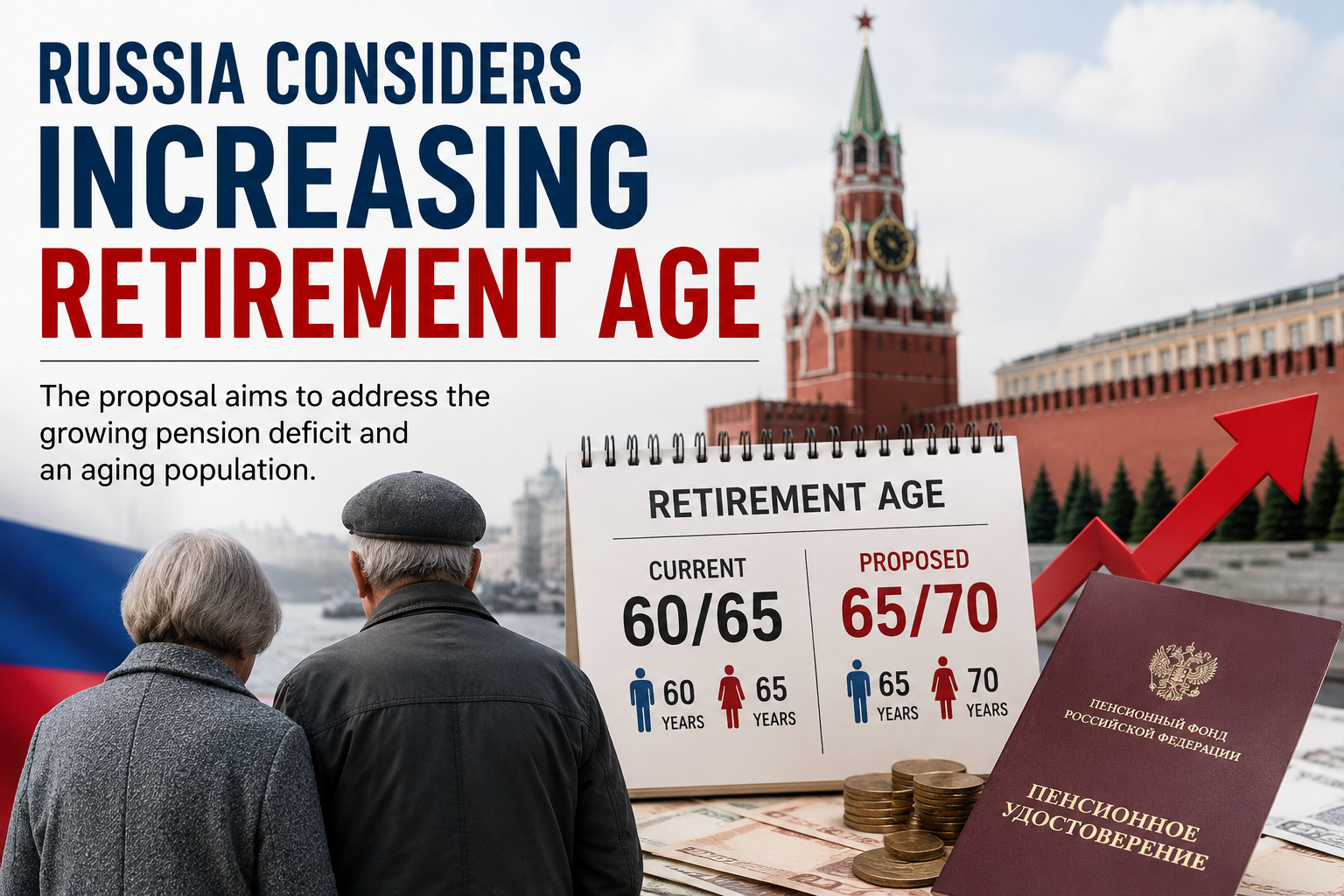
In 2026, that slow-moving reform has pushed the qualifying age for a full state pension to 64 for men and 59 for women. This article explains exactly how that number was reached, why the topic keeps resurfacing in public conversation, what’s driving renewed attention to it, and what the reform’s remaining years will look like for the millions of Russians still waiting to retire.
What Is Russia’s Retirement Age Increase?
At its core, this is a multi-year transition, not a single event. <cite index=”2-1″>The retirement age for men in Russia increased to 64 in 2026, up from 63 in 2025</cite>, while <cite index=”5-1″>the retirement age for women rose to 59 in 2026, up from 58 the previous year</cite>. <cite index=”2-1″>In 2018, the Russian government approved a bill gradually raising the retirement age for men to 65, phased in from the start of 2019 through 2028</cite>, and a parallel schedule applies to women.
Put simply: each year, the bar moves six months higher, until it reaches its final target. That target, and the pace of the increase, is what makes this reform different from a one-time policy change — and why understanding “what happened in 2026” requires understanding the full multi-year arc first.
Why Is This Topic Trending Now?
It’s worth being clear about what is, and isn’t, driving search interest in this topic. There is no confirmed report of a brand-new proposal to raise Russia’s retirement age further or accelerate the existing schedule. Instead, several factors are converging to keep the subject in public view during 2026:
The scheduled 2026 threshold took effect. As outlined above, the qualifying ages moved up another six months this year, a routine but newsworthy step under the existing law.
Russia’s pension fund is under growing financial strain. <cite index=”11-1″>The Russian government has moved to sharply limit withdrawals from its National Welfare Fund, a reserve that helps finance pension payments, after nearly two-thirds of the fund’s liquid assets were spent since the start of the full-scale war in Ukraine</cite>. <cite index=”11-1″>Where the fund held an estimated $113.5 billion before 2022, only around $50 billion remained by late 2025</cite>, and <cite index=”11-1″>for 2026, the Finance Ministry planned to withdraw only about $460 million from the fund — a small fraction of prior years’ withdrawals</cite>.
A widely discussed “gap year” drew fresh attention to the reform’s mechanics. <cite index=”7-1″>Due to the staggered nature of the 2018 reform, 2025 became a year in which almost no Russians qualified for age-based retirement, since those who would have retired in 2022 under the old rules had their eligibility pushed back to 2026 instead</cite>. That quirk of the transition schedule renewed public discussion of exactly when different groups of Russians will actually become eligible.
Pension purchasing power has become a recurring economic story. <cite index=”11-1″>Reports indicate the average Russian pension has fallen to roughly 24% of the average salary — described as the lowest such figure in 17 years — even as the government continues annual indexation increases</cite>.
Background: The 2018 Pension Reform
To understand today’s numbers, it helps to revisit how dramatically Russia’s system changed less than a decade ago. <cite index=”13-1″>Then-Prime Minister Dmitry Medvedev announced the reform in June 2018, proposing to raise the retirement age from 55 to 63 for women and from 60 to 65 for men</cite> — a jump that would have added as much as eight years to women’s working lives.
The announcement landed badly with the public almost immediately. <cite index=”13-1″>Putin’s approval rating fell from roughly 80% to 63% in the weeks following the announcement</cite>, and <cite index=”14-1″>sociologists recorded a steep decline in his approval rating, from about 80% to 70%, alongside surveys showing roughly 90% of Russians opposed the reform outright</cite> — a level of unified public opposition researchers compared only to the emotional reaction, in the opposite direction, to the 2014 annexation of Crimea.
Facing sustained protests, Putin partially reversed course. <cite index=”12-1″>In a televised address on August 29, 2018, he proposed reducing the planned retirement age increase for women, limiting it to 60 rather than the 63 originally proposed</cite>. <cite index=”12-1″>The State Duma passed the amended pension-reform bill in late September 2018, and the Federation Council approved it on October 3, with 149 members in favor, five opposed, and three abstaining; Putin signed it into law the same day</cite>.
The rationale offered by officials centered on demographics and fiscal sustainability. <cite index=”8-1″>Then-Prime Minister Medvedev pointed to a shrinking ratio of working taxpayers to pensioners, warning that without action, the value of pension payments would eventually have to fall</cite>. <cite index=”13-1″>Supporters of the reform noted Russia’s retirement age had remained essentially unchanged since 1932, even as life expectancy had risen substantially since that period</cite>, while critics countered that the comparison understated how much early-Soviet infant mortality had skewed historical life-expectancy figures.
What Exactly Changed in 2026
This year’s development is best understood as one more scheduled step rather than new legislation. <cite index=”3-1″>According to Tatiana Podolskaya, an expert at the Presidential Academy, in 2026 the retirement age is 59 for women (those born in 1967) and 64 for men (those born in 1962), with the transition period continuing until women reach 60 and men reach 65 starting in 2028</cite>.
Financial adjustments accompanied the age threshold change. <cite index=”9-1″>Effective January 1, 2026, Russia’s state insurance pension was indexed by 7.6%, with the fixed base pension set at 9,584.69 rubles (about $121)</cite>. <cite index=”1-1″>The average pension amount for all pensioners, working and non-working, reached 25,254.53 rubles in January 2026 — an increase of roughly 2,000 rubles compared to the same period a year earlier</cite>.
Some categories of workers continue to see separate, more favorable rules. <cite index=”4-1″>Certain groups — including teachers, doctors, mothers of many children, parents or guardians of children with disabilities, and those working in the Far North or similarly designated regions — retain access to earlier retirement under conditions unaffected by the standard age increase</cite>, according to a Public Chamber commission member cited by Russian state news agency TASS.
Timeline of Russia’s Pension Reform
- June 2018 — Prime Minister Dmitry Medvedev announces a proposal to raise the retirement age from 55 to 63 for women and 60 to 65 for men.
- Summer 2018 — Public protests erupt nationwide; Putin’s approval rating falls sharply.
- August 29, 2018 — Putin proposes scaling back the increase for women to 60 rather than 63.
- October 3, 2018 — The Federation Council approves the amended bill; Putin signs it into law the same day.
- 2019 — The gradual, staggered increase begins, rising six months per year for men and three months per year for women.
- 2022 — Retirement eligibility for this cohort is deferred under the transition schedule, eventually pushing their retirement to 2026.
- 2025 — Described by analysts as a “gap year,” in which very few Russians qualify for age-based retirement due to the staggered transition.
- 2026 — The qualifying age reaches 64 for men and 59 for women; pension indexation of 7.6% takes effect; the National Welfare Fund’s role in financing pensions comes under new scrutiny.
- 2028 — The transition is scheduled to conclude for most retirees, with the age reaching 65 for men and 60 for women.
- 2034 — For female government officials specifically, the retirement age is scheduled to continue rising until it reaches 63.
Official Government Statements
Russian officials have generally framed the ongoing reform in technical, procedural terms rather than as newly contested policy. <cite index=”3-1″>Presidential Academy expert Tatiana Podolskaya described the 2026 thresholds to the state news agency RIA Novosti in matter-of-fact terms, confirming the specific birth-year cohorts affected</cite>. <cite index=”4-1″>Public Chamber commission member Evgeny Masharov, speaking to TASS, outlined the eligibility requirements for 2026 retirees, including a minimum insurance record of 15 years and at least 30 individual pension coefficients</cite>.
No senior Russian official has issued a public statement in 2026 proposing to accelerate or expand the retirement age increase beyond what the 2018 law already established, based on available reporting.
Public Reaction and Protests
Public reaction to the original 2018 reform was intense and well documented, though it has not been repeated at the same scale during the reform’s subsequent, more incremental years. <cite index=”14-1″>At the height of the 2018 backlash, opposition to the plan was described as nearly universal, cutting across the usual divides in Russian public opinion</cite>. Sustained protests followed the initial announcement in cities across the country, and the issue became one of the defining domestic controversies of Putin’s fourth presidential term.
By contrast, the annual, incremental steps that have followed — including 2026’s shift to 64 and 59 — have not generated comparable public demonstrations, based on available reporting. This is consistent with a broader pattern in which the most visible public resistance in Russia has tended to concentrate around major policy announcements rather than their scheduled, pre-legislated implementation.
Expert Opinions
Analysts examining Russia’s pension system have pointed to demographic and fiscal pressures as the reform’s underlying drivers. <cite index=”13-1″>At the time of the 2018 reform, official Rosstat data showed a shrinking ratio of workers to pensioners — down to roughly 2.3 workers per pensioner from 3-to-1 in 2002 — a trend cited by the government as justification for the change</cite>.
More recent commentary has focused on the reform’s financial adequacy rather than its underlying logic. <cite index=”11-1″>Analysts at Pension Policy International noted that Russia’s pension fund deficit exceeded $9.3 billion in 2025, even as the government continued to indexed pension payments upward each year</cite> — a sign, in their assessment, that the retirement age increase alone has not resolved the system’s structural funding pressures.
Economic Impact and Pension Fund Pressures
The clearest economic thread running through 2026’s pension news is the state of Russia’s reserve funding. <cite index=”11-1″>Since Russia’s full-scale invasion of Ukraine began, the government has drawn down the National Welfare Fund considerably, and for 2026 it planned to withdraw only about 38.5 billion rubles (roughly $460 million) — tens of times less than in prior years</cite>. <cite index=”11-1″>Analysts linked this shift to declining oil and gas revenue amid Western sanctions, warning that the burden of financing both the war and social spending is increasingly falling on the general population through higher taxes and reduced program spending</cite>.
At the same time, the government has continued to increase nominal pension payments to offset inflation. <cite index=”9-1″>Beyond the January indexation, other 2026 measures include an increase in the per-capita subsistence minimum to 18,939 rubles and a rise in the national minimum wage to 27,093 rubles, both of which factor into pension-related calculations</cite>.
The net effect, according to available reporting, is a system attempting to balance two competing pressures: rising nominal payments intended to track inflation, and a shrinking pool of reserve funding to draw upon if oil and gas revenues continue to underperform.
Political Implications
The 2018 reform remains one of the more politically costly domestic decisions of Putin’s presidency, even years later. <cite index=”13-1″>In the regional elections that followed the reform’s passage, four incumbent governors from Putin’s United Russia party were forced into unusual second-round runoff votes</cite> — a rare electoral setback for the ruling party at the time.
Whether the reform’s ongoing, incremental implementation carries similar political risk in 2026 is harder to assess from available reporting. Unlike the original 2018 announcement, this year’s scheduled increase has not been linked to any comparable public opinion shift or electoral consequence in available sources.
Who Is Affected?
The reform affects the vast majority of Russians approaching retirement age, with specific exceptions carved out for certain professions and family circumstances. <cite index=”4-1″>Early retirement provisions remain available for teachers, doctors, mothers with many children, parents or guardians of children with disabilities, workers with long service records in hazardous conditions, and those employed in the Far North or comparable regions</cite>. <cite index=”4-1″>Separately, military personnel, cosmonauts, and ballet and theater performers retain access to distinct early-retirement rules</cite>.
<cite index=”7-1″>Female government officials face a longer transition than the general population: while most Russians’ reform concludes in 2028, women in government roles will see their retirement age continue rising until it reaches 63 in 2034</cite>. <cite index=”7-1″>This extended timeline traces back to a compromise during the reform’s original drafting, when lawmakers agreed to limit the general increase for women to five years rather than the eight years initially proposed, while leaving a longer transition in place for this specific group</cite>.
<cite index=”4-1″>Those who lack sufficient work experience to qualify for an insurance pension remain entitled to a social pension instead, though it becomes available five years later and pays a lower amount</cite>.
What Could Happen Next?
Based on current, verified information, the retirement age increase is expected to proceed exactly as scheduled under the 2018 law: continuing in six-month increments for men and three-month increments for women until the transition concludes in 2028, with the separate track for female officials continuing until 2034. No credible reporting reviewed for this article indicates the Russian government has proposed extending the age thresholds further or accelerating the existing timeline.
The larger open question concerns funding, not the age threshold itself. Given the National Welfare Fund’s declining balance and the pension system’s persistent deficit, it remains to be seen whether the government will need to introduce additional measures — whether through taxation, further reserve drawdowns, or adjustments to indexation formulas — to keep pension payments sustainable through the remainder of the transition period and beyond. This is a developing area, and any concrete new policy proposals should be treated as unconfirmed until officially announced.
Key Facts
- 2026 retirement age: 64 for men (born 1962), 59 for women (born 1967)
- Final target age: 65 for men, 60 for most women, both by 2028
- Extended track: Female government officials continue rising to 63 by 2034
- Reform origin: Signed into law by President Putin on October 3, 2018
- Original proposal: 65 for men, 63 for women (later reduced to 60 for women)
- 2026 pension indexation: 7.6% increase to the state insurance pension
- Average pension, January 2026: 25,254.53 rubles (all pensioners)
- National Welfare Fund: Declined from an estimated $113.5 billion pre-2022 to roughly $50 billion by late 2025
- 2025 pension fund deficit: Exceeded $9.3 billion, according to analyst estimates
Frequently Asked Questions
Did Russia just announce a new retirement age increase in 2026? No. There is no confirmed new legislative proposal in 2026 to raise the retirement age beyond what was already scheduled under the 2018 reform. This year’s change to 64 (men) and 59 (women) is the next scheduled step in that existing, multi-year transition.
What was Russia’s retirement age before the 2018 reform? Before the reform, the retirement age was 60 for men and 55 for women — among the lowest in Europe at the time.
When will Russia’s retirement age reform be complete? For most Russians, the transition concludes in 2028, when the age reaches 65 for men and 60 for women. Female government officials follow a separate, longer schedule concluding in 2034 at age 63.
Why did Russia raise the retirement age in the first place? Officials cited a shrinking ratio of working taxpayers to pensioners and long-term concerns about the pension fund’s fiscal sustainability, along with rising life expectancy compared to when the previous retirement ages were set in 1932.
Are there exceptions to the retirement age increase? Yes. Teachers, doctors, mothers with many children, parents or guardians of children with disabilities, workers in hazardous or northern conditions, military personnel, cosmonauts, and certain performing artists retain access to earlier retirement under separate rules.
How has the war in Ukraine affected Russia’s pension system? Reserve funding available to help finance pensions — held in the National Welfare Fund — has declined substantially since 2022, and planned withdrawals from the fund for 2026 were sharply reduced compared to prior years, raising questions about long-term funding sustainability.
Did the retirement age increase cause protests? Yes, significantly so when it was first announced in 2018, triggering nationwide protests and a notable decline in President Putin’s approval ratings. Subsequent annual, incremental increases have not generated comparable public demonstrations, based on available reporting.
Conclusion
Russia’s retirement age increase isn’t breaking news in the traditional sense — it’s the latest chapter of a story that began in 2018, when a single policy announcement briefly shook public confidence in Putin’s government more than almost any other domestic decision of his presidency. What’s happening in 2026 is quieter but still consequential: another six-month step forward in a reform that, by 2028, will have fully repositioned when most Russians can retire. Layered on top of that scheduled change is a less predictable story — a pension fund under real financial strain, shaped by years of war-related spending and declining energy revenue. Together, these two threads, one procedural and one financial, are what’s keeping Russia’s retirement age in the headlines this year.