
Introduction
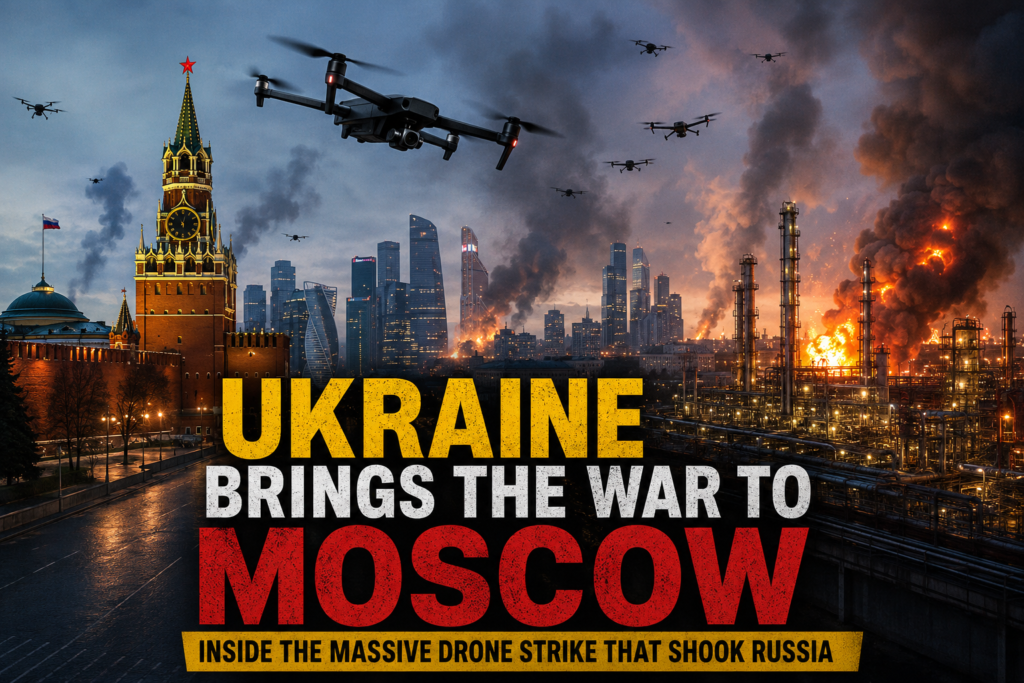
Ukraine Brings the War to Moscow has become one of the most discussed developments in the Russia-Ukraine conflict. The latest large-scale drone attack near Moscow highlights Ukraine’s growing ability to strike deep inside Russian territory and raises new questions about security, military strategy, and the future direction of the war.
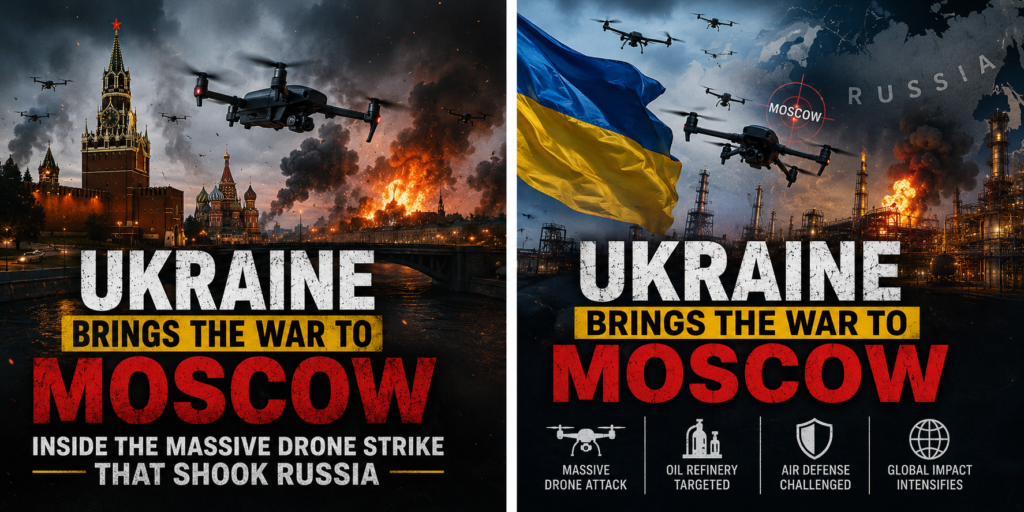
The war between Russia and Ukraine entered a dramatic new phase on June 18, 2026, as Ukraine launched one of its largest drone attacks against targets deep inside Russian territory. Powerful explosions were reported near Moscow, including at a major oil refinery, while Russian authorities claimed to have intercepted hundreds of drones across multiple regions.
The attacks represent a significant shift in the conflict, demonstrating Ukraine’s growing ability to strike strategic infrastructure far from the front lines. For Russia, the incident raises serious questions about homeland security, air defense capabilities, and the vulnerability of critical energy infrastructure.
As both countries continue to intensify military operations, analysts warn that the conflict may be entering an even more dangerous stage, with increasing risks for regional stability, global energy markets, and international security.

A New Chapter in the Russia-Ukraine War
Since the beginning of the conflict, much of the fighting has occurred inside Ukrainian territory. However, over the past two years, Ukraine has steadily expanded its capability to conduct long-range strikes against military and economic targets inside Russia.
The June 18 attack stands out because of both its scale and its symbolic significance.
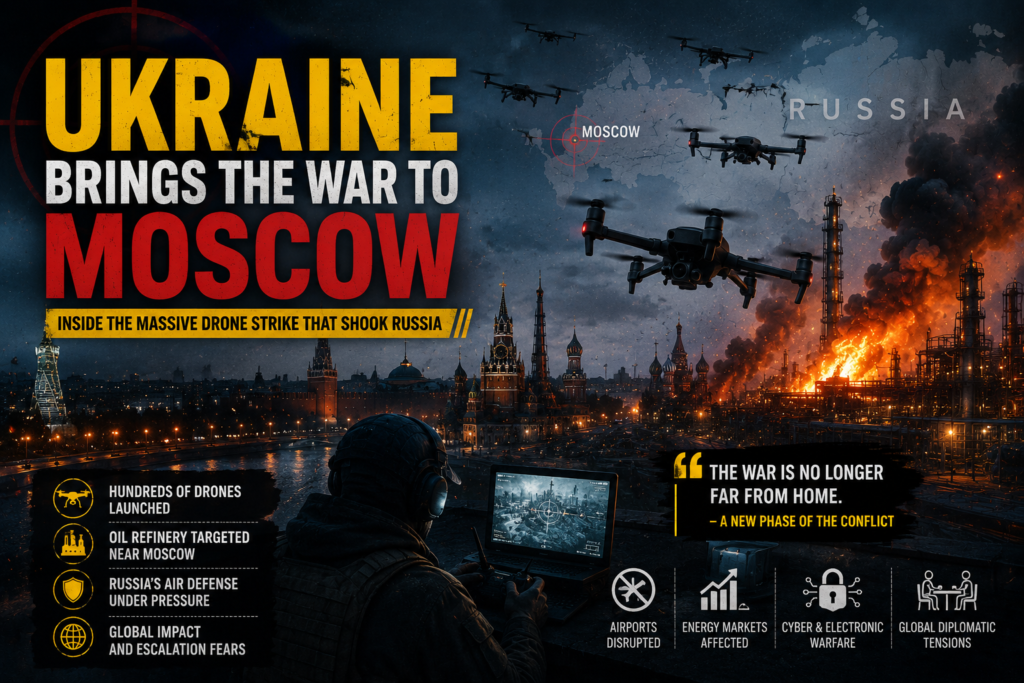
According to Russian officials, hundreds of drones targeted multiple regions, including the Moscow area. Explosions were reported near strategic infrastructure sites, forcing authorities to temporarily restrict operations at several airports and activate emergency response teams.
For many Russians, the attack served as a reminder that the war is no longer a distant conflict taking place hundreds of kilometers away. Instead, it has increasingly reached Russian cities and industrial centers.
Why Moscow Matters
Moscow is not only Russia’s political capital but also the center of the country’s economic and military decision-making.
Any successful strike near Moscow carries enormous symbolic value.
While the physical damage may be limited compared to battlefield losses, attacks on the capital create psychological pressure and attract global media attention.
Military analysts note that Ukraine’s objective may not necessarily be large-scale destruction. Instead, such operations can:
- Force Russia to divert air-defense systems.
- Increase security costs.
- Create uncertainty among the public.
- Demonstrate Ukraine’s technological capabilities.
- Send political messages to both domestic and international audiences.
In modern warfare, perception often matters as much as physical damage.
The Oil Refinery Target
One of the most significant aspects of the attack was the reported strike on a major oil refinery near Moscow.
Energy infrastructure has become a central target throughout the conflict.
Ukraine argues that oil facilities play a direct role in supporting Russia’s military operations by generating revenue and supplying fuel.
Targeting refineries can have several effects:
- Disrupt fuel production.
- Increase repair costs.
- Reduce export capacity.
- Create pressure on energy markets.
Russia remains one of the world’s largest energy producers, making such facilities strategically important.
Although Russian officials often report successful interceptions of incoming drones, repeated attacks on energy infrastructure indicate that some Ukrainian systems continue to penetrate Russian defenses.
Russia’s Air Defense Challenge
Following the attack, Russian authorities stated that hundreds of drones were intercepted.
Even if those claims are accurate, the sheer number of drones involved highlights a growing challenge.
Modern drone warfare differs significantly from traditional missile warfare.
Drones are:
- Cheaper to produce.
- Easier to deploy.
- Harder to detect.
- Capable of overwhelming defenses through large numbers.
Military experts describe this approach as “saturation attacks,” where dozens or hundreds of drones are launched simultaneously to overwhelm air-defense systems.
The Russia-Ukraine conflict has become one of the world’s most important testing grounds for drone warfare.
Lessons learned on the battlefield today may influence military planning around the world for years to come.
Zelensky’s Strategic Message
Ukrainian President Volodymyr Zelensky has repeatedly emphasized that Russia must experience the consequences of continuing the war.
From Kyiv’s perspective, attacks on military and economic infrastructure inside Russia are intended to change Moscow’s calculations.
Supporters argue these operations:
- Increase pressure on Russian leadership.
- Disrupt military logistics.
- Demonstrate Ukrainian resilience.
- Strengthen morale among Ukrainian citizens.
Critics, however, warn that strikes inside Russia may lead to further escalation.
The debate reflects a broader question facing both sides: can military pressure create conditions for peace, or does it simply prolong the conflict?
Economic Consequences
The Russia-Ukraine war has already had major economic effects worldwide.
The latest attacks could influence:
Energy Markets
Oil and gas traders closely monitor developments involving Russian infrastructure.
Any threat to production or transportation can affect prices.
Investment Confidence
Investors generally dislike uncertainty.
Escalation may discourage investment and increase market volatility.
Transportation
Temporary airport closures and security measures can disrupt travel and logistics.
Insurance Costs
Companies operating in conflict-affected regions often face higher insurance premiums and operating expenses.
Even limited attacks can generate significant economic ripple effects.
The Future of Drone Warfare
The attack highlights the growing importance of drones in modern conflict.
Both Russia and Ukraine have invested heavily in:
- Long-range drones.
- Artificial intelligence systems.
- Electronic warfare.
- Counter-drone technology.
Future conflicts around the world are likely to be influenced by lessons learned in Ukraine.
Military planners increasingly view drones as essential components of national defense strategies.
What was once considered supplementary technology has become a central feature of modern warfare.
International Reactions
Governments across Europe, North America, and Asia continue to monitor developments closely.
The conflict remains one of the most significant geopolitical challenges of the 21st century.
International concerns include:
- Regional stability.
- Nuclear security.
- Global food supplies.
- Energy security.
- Refugee movements.
Every major escalation attracts attention from policymakers worldwide.
The latest attacks near Moscow are likely to generate renewed discussions about military assistance, sanctions, and diplomatic efforts.
Could the Conflict Escalate Further?
One of the biggest concerns among analysts is the possibility of further escalation.
Potential scenarios include:
- Increased drone attacks.
- Expanded missile strikes.
- Cyber warfare operations.
- Additional sanctions.
- Intensified military campaigns.
While neither side has shown signs of abandoning its objectives, the costs of the conflict continue to grow.
This creates a difficult environment for diplomacy.
Conclusion
The June 18 drone attacks near Moscow mark another significant milestone in the Russia-Ukraine war. Whether viewed as a strategic success for Ukraine or a security challenge for Russia, the operation demonstrates how modern warfare is evolving.
Drones, technology, and economic infrastructure are becoming just as important as tanks and artillery. As both sides continue to adapt, the conflict is likely to remain one of the most closely watched international crises in the world.
For now, the attack serves as a powerful reminder that the war is far from over—and that its consequences continue to reach far beyond the battlefield.