
Introduction
Every election cycle introduces new legal disputes, but only a handful evolve into national conversations that extend far beyond politics. The recent Harmeet Dhillon voting letters are one such example. What began as official correspondence between the U.S. Department of Justice (DOJ) and election officials in several states has quickly developed into a broader debate about constitutional authority, election integrity, and the relationship between federal and state governments.
At first glance, the letters may appear to be routine requests for information. Federal agencies regularly communicate with state governments on matters involving compliance with federal law. Yet the unusually strong public reaction demonstrates that election administration occupies a unique place in American democracy. When federal officials seek detailed information about voting procedures—particularly during an election cycle—the discussion rarely remains confined to administrative policy. Instead, it often expands into larger questions about public trust, legal authority, and the rules that govern democratic elections.
The controversy surrounding these letters is therefore not simply about paperwork or legal correspondence. It reflects years of political debate over how elections should be managed, who has the authority to oversee them, and what role the federal government should play in ensuring that election laws are enforced consistently across the country.
Supporters of the DOJ’s actions argue that the department is fulfilling one of its core responsibilities: enforcing federal laws designed to protect the integrity of elections. From their perspective, asking states to explain how they verify voter eligibility and maintain voter registration records is neither unusual nor controversial. Instead, they see the requests as part of a broader effort to strengthen public confidence in the electoral process.
Critics reach a different conclusion. They contend that although the federal government has an important role in enforcing election laws, states remain primarily responsible for administering elections under the U.S. Constitution. They argue that aggressive federal inquiries—even when framed as requests for information—can create unnecessary pressure on local election officials and blur the constitutional line between federal oversight and state administration.
These competing viewpoints help explain why the story has attracted widespread attention from journalists, constitutional scholars, lawmakers, election officials, and voters alike. The debate extends well beyond the specific language contained in the letters. Instead, it raises broader questions about transparency, accountability, voter confidence, and the evolving relationship between federal institutions and state governments.
Another reason the story has gained national attention is its timing. Public confidence in elections has become one of the defining political issues of the past decade. Questions surrounding voter registration, election security, ballot access, and administrative transparency continue to shape legislative debates across the United States. Against that backdrop, even routine actions taken by the Department of Justice are likely to receive significant public scrutiny.
Rather than approaching this issue through a partisan lens, this guide examines the controversy from multiple perspectives. It explores what the letters requested, why they were sent, how election officials have responded, what legal questions they raise, and why the discussion is likely to continue long after the current news cycle ends.
Whether you follow American politics closely or are simply trying to understand why Harmeet Dhillon voting letters became a trending search topic, understanding the broader legal and constitutional context provides a clearer picture than headlines alone can offer.
Why This Story Is Bigger Than One Set of Letters
One reason this controversy has attracted such widespread attention is that it reflects a larger transformation in how Americans view elections. Over the past decade, election administration has become one of the most closely examined areas of public policy. Issues that were once discussed mainly among lawyers and election officials are now part of everyday political conversation.
This shift has changed how the public responds to actions taken by government agencies. A letter that might once have attracted little attention can now generate nationwide headlines within hours, especially when it involves voting rights, election security, or constitutional authority.
The Harmeet Dhillon voting letters arrived during a period when public interest in election administration is exceptionally high. As a result, the debate quickly expanded beyond the specific requests contained in the correspondence. Instead, the letters became a symbol of broader disagreements about how elections should be supervised and who should ultimately be responsible for protecting public confidence in democratic institutions.
In many ways, this explains why the controversy has remained in the national spotlight. People are not simply debating the content of the letters themselves. They are debating the future of election oversight in the United States.
Who Is Harmeet K. Dhillon?
Understanding the controversy begins with understanding the public official whose name appears on the letters.
Harmeet Kaur Dhillon is an American attorney whose legal career has focused on constitutional law, civil rights, and election-related litigation. Before joining the Department of Justice, she built a national profile representing clients in cases involving freedom of speech, religious liberty, employment law, and constitutional protections. Her work frequently placed her at the center of nationally significant legal disputes, making her one of the most recognizable conservative attorneys in the country.
Beyond private practice, Dhillon has also been active in Republican politics, serving in leadership roles within the Republican National Committee and participating in public discussions concerning election law and constitutional issues. Those experiences contributed to her reputation as a lawyer deeply involved in debates over the interpretation and application of federal law.
In 2025, she was confirmed by the U.S. Senate as Assistant Attorney General for the Civil Rights Division of the Department of Justice. The position carries significant responsibility because the Civil Rights Division enforces numerous federal statutes relating to voting rights, discrimination, disability access, hate crimes, and constitutional protections.
Since assuming office, Dhillon has consistently emphasized the importance of election integrity. In public remarks, she has argued that maintaining accurate voter registration systems and ensuring compliance with federal law are essential to preserving confidence in democratic elections. Supporters view these priorities as consistent with the division’s mission, while critics argue that the practical implementation of those priorities must remain carefully balanced against state authority and voting rights protections.
Regardless of political opinion, Dhillon’s role places her at the center of one of the most significant legal and political debates currently shaping election policy in the United States.
What Did the DOJ Actually Request?
One of the biggest reasons the Harmeet Dhillon voting letters have attracted so much attention is that many people have discussed the controversy without first understanding what the Department of Justice actually requested. Reading headlines alone can create the impression that the federal government attempted to change election procedures across the country. However, the issue is more nuanced than that.
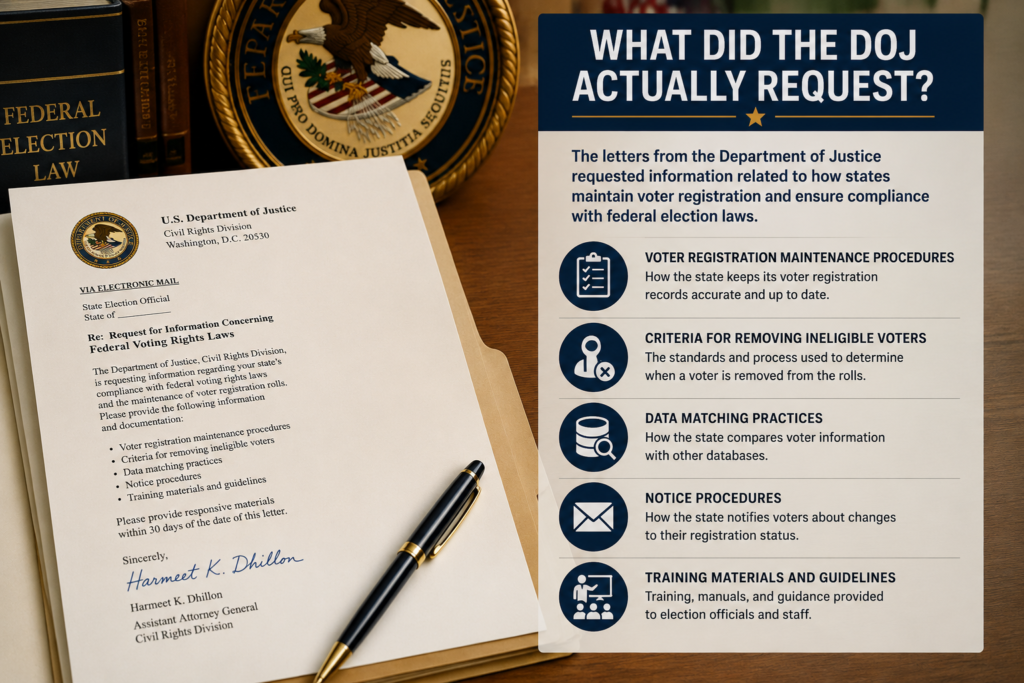
According to publicly available information, the letters asked election officials in several states to explain how their offices comply with federal laws governing voter eligibility and voter registration maintenance. Rather than announcing new election rules, the correspondence sought information about existing procedures already used by state election agencies.
Among the questions reportedly raised in the letters were how states verify that only eligible citizens remain on voter registration rolls, what procedures are followed when election officials identify registrations that may no longer be valid, and how states ensure compliance with federal laws prohibiting non-citizens from voting in federal elections.
Although these topics are part of routine election administration, the timing and wording of the letters immediately attracted national attention. Election administration has become one of the most politically sensitive areas of public policy in the United States, meaning even ordinary requests for information can quickly become the subject of intense public debate.
This is an important distinction because much of the controversy is not about the questions themselves. Instead, it concerns whether the Department of Justice’s approach represents ordinary oversight or a broader expansion of federal involvement in elections traditionally administered by state governments.
Why Election Administration Is So Sensitive
To understand the public reaction, it helps to recognize that elections occupy a unique position within American democracy. Few government responsibilities receive the same level of public attention because elections determine political leadership at every level of government.
Unlike many administrative functions, election procedures directly influence public confidence in democratic institutions. When confidence declines, questions about legitimacy often follow. As a result, actions taken by election officials—and by agencies responsible for enforcing election laws—are examined far more closely than similar actions in many other areas of government.
This explains why the DOJ letters became national news almost immediately. They arrived during a period when Americans remain deeply interested in issues such as election security, voter registration, ballot access, and transparency. Against that backdrop, correspondence that might once have attracted little public attention instead became the focus of nationwide discussion.
Why Did the Department of Justice Become Involved?
Understanding the Department of Justice’s role requires looking beyond the current controversy.
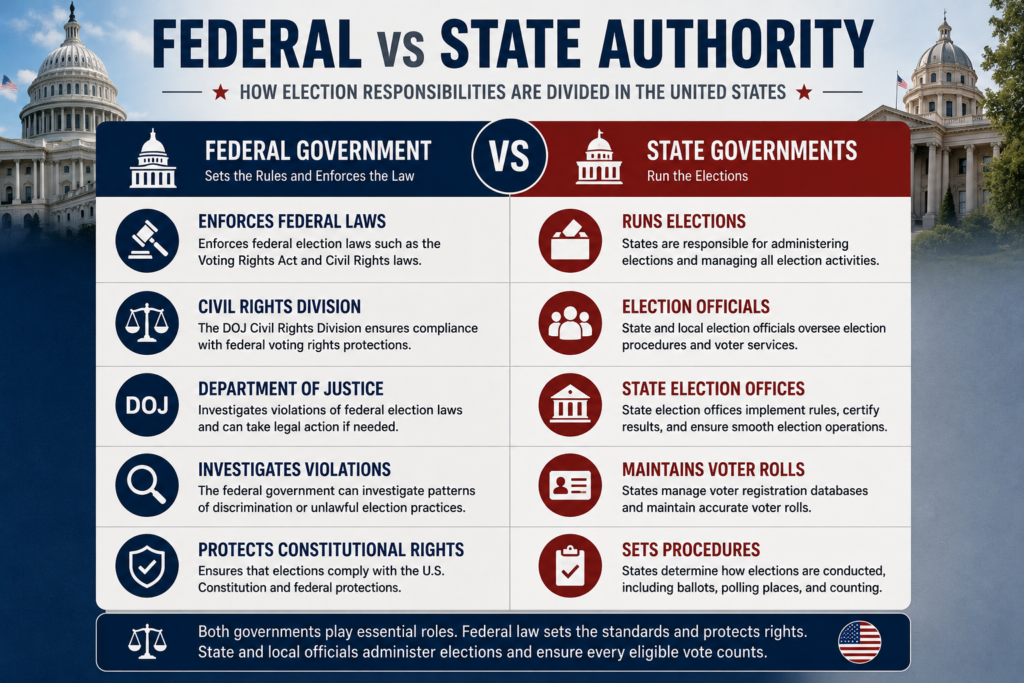
The DOJ is not responsible for running elections. That responsibility belongs primarily to state and local governments. Instead, the department enforces federal laws passed by Congress, including laws relating to voting rights, civil rights, election-related crimes, and constitutional protections.
When DOJ officials request information from state agencies, they generally argue that they are carrying out oversight responsibilities assigned under federal law. Supporters of the recent letters therefore see the requests as consistent with the department’s existing mission rather than a significant change in policy.
Critics interpret the situation differently.
Many constitutional scholars note that while Congress possesses authority to regulate certain aspects of federal elections, the Constitution also reserves substantial authority for states to administer elections themselves. Because of that balance, critics argue that any federal action touching election administration should be approached carefully to avoid creating unnecessary tension between state and federal governments.
The disagreement is therefore less about whether federal election laws exist and more about how those laws should be enforced in practice.
Understanding the National Voter Registration Act (NVRA)
No discussion of the Harmeet Dhillon voting letters would be complete without examining the National Voter Registration Act of 1993, commonly referred to as the NVRA.
Although the law was enacted more than three decades ago, it continues to shape how states maintain voter registration systems today.
The NVRA pursued two goals that sometimes appear to pull in opposite directions.
The first objective was expanding voter participation by making registration easier for eligible citizens. Congress sought to reduce unnecessary barriers that discouraged people from registering to vote.
The second objective was ensuring that voter registration lists remained accurate over time. As people move, change legal status, or pass away, election officials must update registration databases so that records remain current.
Balancing these two objectives has never been simple.
If voter registration systems are updated too slowly, outdated records may remain in official databases. If updates occur too aggressively, eligible voters risk being removed by mistake.
This balancing act explains why election law often becomes the subject of litigation. Both election security and voter access are legitimate public interests, and lawmakers have long attempted to protect both at the same time.
Supporters of the DOJ letters argue that asking states how they maintain voter registration records is consistent with the NVRA’s goal of ensuring accurate voter rolls.
Critics counter that the same law also contains safeguards designed to prevent eligible voters from being improperly removed. In their view, any discussion of voter registration maintenance must consider both objectives equally rather than emphasizing only one.
Federal Authority vs. State Authority
Perhaps no legal question has generated more discussion than the constitutional relationship between the federal government and the states.
The U.S. Constitution gives states primary responsibility for administering elections. State governments establish polling places, manage voter registration systems, certify election results, and oversee the day-to-day administration of elections.
However, Congress also possesses constitutional authority to regulate aspects of federal elections through legislation.
Over many decades, Congress has enacted laws addressing issues such as voting rights, election accessibility, campaign finance, military and overseas voting, and voter registration procedures.
Because both levels of government possess legitimate responsibilities, disagreements sometimes arise regarding where one authority ends and the other begins.
Supporters of stronger federal oversight argue that national elections require consistent enforcement of federal law regardless of which state conducts the election.
Others argue that preserving state independence remains equally important because states have historically administered elections under their own legal systems.
This constitutional balance has never been static. Instead, it has evolved through legislation, court decisions, and changing interpretations of federal authority.
The current controversy surrounding the Harmeet Dhillon voting letters represents another chapter in that ongoing constitutional conversation rather than an entirely new legal dispute.
Why Legal Experts Disagree
One of the most interesting aspects of this controversy is that respected legal scholars have reached different conclusions while examining the same events.
Some experts argue that requesting information from state election officials falls comfortably within the Department of Justice’s existing enforcement authority. From their perspective, gathering information is an ordinary part of determining whether federal laws are being followed.
Other scholars are more cautious.
They acknowledge that federal oversight serves an important purpose but argue that election administration has traditionally remained under state control. Because elections directly affect democratic legitimacy, they believe federal agencies should exercise restraint when communicating with state officials unless there is evidence suggesting that federal law has actually been violated.
Neither position rejects the importance of election integrity. Instead, the disagreement centers on how constitutional authority should be exercised while preserving both accountability and state independence.
For many observers, this legal debate—not simply the letters themselves—is what makes the controversy particularly significant.
How Did States Respond to the DOJ Letters?
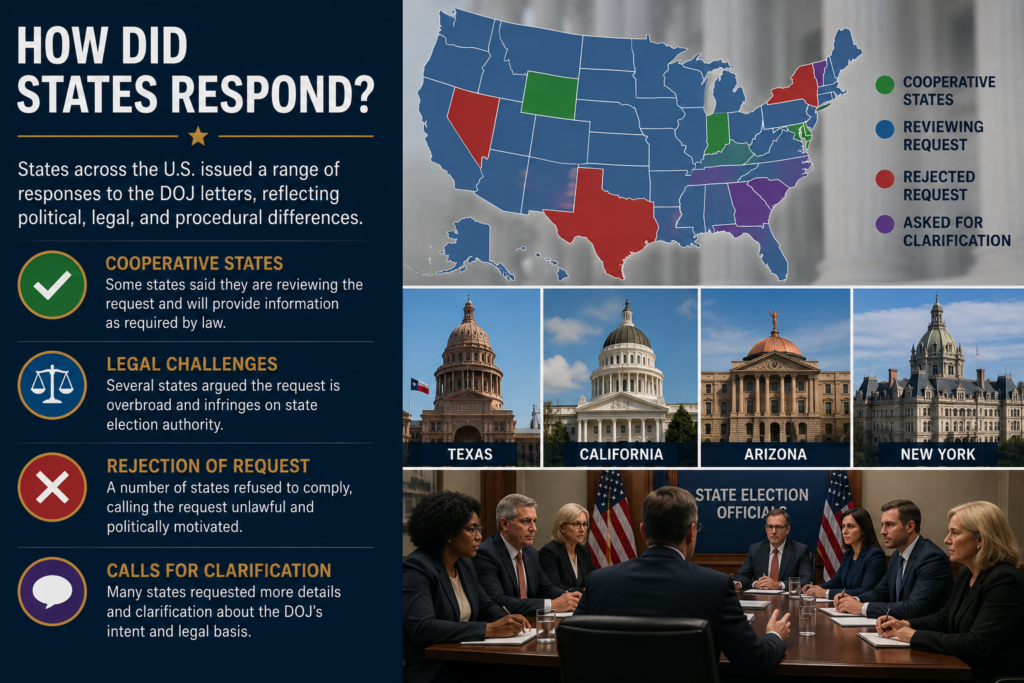
Once news of the Department of Justice’s letters became public, election officials across several states began responding in different ways. While some agencies indicated that they would review the requests and provide information where appropriate, others questioned both the tone of the correspondence and the legal authority behind certain requests.
The different reactions were not surprising. Election administration varies considerably from one state to another. Each state has its own constitution, election code, voter registration system, and administrative procedures. As a result, officials often approach similar federal requests from different legal and practical perspectives.
Some election administrators emphasized that they already conduct regular voter list maintenance as required under both state and federal law. Others noted that their offices routinely cooperate with federal agencies when appropriate but stressed that voter information is protected by state privacy laws and cannot simply be shared without following established legal procedures.
These responses highlight an important point often overlooked in public discussions. Election officials are not only responsible for maintaining accurate voter rolls—they must also ensure that every action complies with constitutional protections, privacy laws, and court decisions. Their role therefore involves balancing multiple legal obligations at the same time.
Why Supporters Believe the Letters Were Necessary
Supporters of the Department of Justice argue that the controversy has overshadowed what they consider to be a straightforward objective: ensuring that federal election laws are applied consistently across the country.
From this perspective, requesting information from state election officials is not an attempt to interfere with local administration but rather a method of understanding how existing laws are being implemented. They argue that transparency strengthens public confidence because voters expect government agencies to verify that election systems are functioning properly.
Another common argument focuses on consistency. While states administer elections independently, federal elections ultimately determine representation in Congress and the presidency. Supporters believe that maintaining a consistent level of compliance with federal law across all states helps reinforce confidence in national election outcomes.
Some legal analysts also point out that government oversight does not necessarily require immediate enforcement action. In many situations, agencies begin by gathering information before determining whether any further action is necessary. Viewed through this lens, the letters represent an early step in an oversight process rather than evidence of wrongdoing by any particular state.
Why Critics Remain Concerned
Despite those arguments, criticism has remained strong among many election officials, constitutional scholars, and voting rights organizations.
One concern involves the potential expansion of federal authority. Critics acknowledge that the Department of Justice has an important role in enforcing federal election laws, but they argue that routine election administration has historically remained the responsibility of state governments. From their perspective, preserving that balance is essential to the constitutional structure of the United States.
Another concern relates to administrative pressure. Election offices often operate with limited staff while preparing for voter registration deadlines, ballot printing, poll worker training, and election security planning. Responding to extensive federal requests during busy election periods may require resources that would otherwise be dedicated to election preparation.
Privacy has also become an important issue. Voter registration databases contain sensitive personal information, including names, addresses, and identifying details protected under various state and federal laws. Election officials therefore have legal obligations not only to maintain accurate records but also to safeguard the information entrusted to their offices.
Voting rights advocates raise an additional point. They argue that efforts to improve election security should always be accompanied by equal attention to protecting the rights of eligible voters. Policies intended to strengthen voter list maintenance must be implemented carefully to avoid creating unnecessary barriers for lawful voters.
A Practical Example: Why Voter Registration Maintenance Is More Complex Than It Appears
To understand why this issue is so controversial, consider a practical example.
Imagine a state with more than seven million registered voters. Every month, thousands of residents move to new addresses, some become naturalized U.S. citizens, others pass away, and many change their legal names after marriage or other life events.
Election officials must continuously update registration records to reflect these changes. They receive information from multiple government agencies, compare records across databases, and follow procedures established by state and federal law before removing or updating registrations.
This process is far from automatic. Records may contain spelling differences, outdated addresses, or incomplete information. In some cases, two individuals may share similar names or dates of birth, requiring additional verification before any administrative action can be taken.
For that reason, election administrators often describe voter registration maintenance as an ongoing process of verification rather than a simple database cleanup. The challenge is ensuring that outdated records are corrected while protecting eligible voters from accidental removal.
This example helps explain why debates surrounding voter registration frequently become legal as well as political. Both election security and voter access depend on accurate information, careful procedures, and compliance with multiple overlapping laws.
Why This Debate Extends Beyond Election Officials
Although the controversy began with letters sent to state agencies, its implications extend much further.
For lawmakers, the discussion may influence future legislation concerning voter registration standards, election administration, and federal oversight.
For courts, constitutional questions raised by the controversy could eventually require judicial interpretation, particularly if disagreements between state and federal officials develop into formal legal disputes.
For election administrators, the controversy may encourage additional reviews of existing procedures, documentation practices, and communication with federal agencies.
For voters, the debate influences public confidence in democratic institutions. Regardless of political affiliation, most citizens expect elections to be conducted fairly, transparently, and according to law. Maintaining that confidence requires cooperation between governments, clear legal standards, and effective communication with the public.
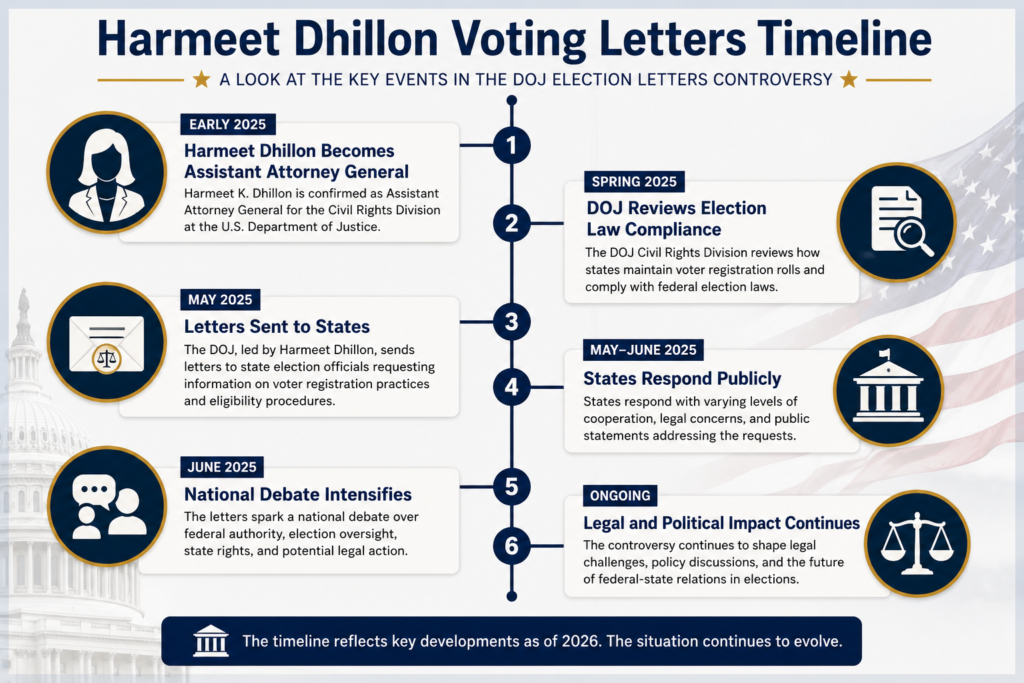
Timeline of Key Events
| Date | Event |
|---|---|
| 2025 | Harmeet K. Dhillon is confirmed as Assistant Attorney General for the Civil Rights Division. |
| Early 2026 | Election integrity remains one of the DOJ’s publicly stated enforcement priorities. |
| 2026 | The Department of Justice sends letters to election officials in several states requesting information regarding voter registration maintenance and compliance with federal law. |
| Shortly After | State election officials begin responding publicly, with reactions varying by jurisdiction. |
| Following Weeks | Legal scholars, journalists, and constitutional experts debate the implications of the letters, drawing national media attention. |
Why This Story Matters Beyond Today’s Headlines
Political controversies often disappear as quickly as they emerge, but election law disputes tend to have longer-lasting consequences.
Court decisions, legislative reforms, and administrative guidance issued in response to one controversy frequently shape how future elections are conducted. For that reason, the significance of the Harmeet Dhillon voting letters extends beyond the specific correspondence sent in 2026.
The broader debate centers on enduring questions that have challenged lawmakers for decades:
- How should election integrity be protected?
- What responsibilities belong to state governments?
- When should the federal government intervene?
- How can election systems remain both secure and accessible?
- What legal safeguards best protect public confidence?
These questions do not have simple answers. Instead, they require ongoing cooperation between legislators, election officials, courts, and the public.
Regardless of where readers stand politically, understanding the legal and constitutional issues behind the controversy provides a more complete picture than headlines alone. The letters may have initiated the discussion, but the larger conversation concerns the future of election administration in the United States.
Beyond Today’s Headlines
Political controversies often dominate the news for a few days before being replaced by the next major story. Election law disputes, however, tend to follow a different pattern. Rather than disappearing quickly, they frequently influence legislation, court decisions, and administrative practices for years.
The Harmeet Dhillon voting letters are a good example of this pattern. Although the immediate discussion focuses on a series of DOJ letters sent to state election officials, the broader questions they raise are unlikely to disappear once media attention fades. Instead, they may become part of a continuing national conversation about how elections should be administered and who should ultimately be responsible for protecting public confidence in the democratic process.
For election administrators, the controversy serves as a reminder that nearly every administrative decision can attract public scrutiny. For lawmakers, it highlights the continuing challenge of balancing election security with voting accessibility. For courts, it presents another opportunity to clarify how constitutional authority should be divided between federal and state governments.
In many ways, the letters represent not the beginning or the end of a debate, but another chapter in an ongoing discussion that has shaped American election law for decades.
Lessons from Previous Election Disputes
The United States has experienced numerous election-related legal disputes throughout its history. While the issues have varied, many have involved similar constitutional themes: the balance of power between states and the federal government, the protection of voting rights, and the integrity of the electoral process.
One lesson that consistently emerges is that changes to election administration often take time. Significant reforms usually result from a combination of legislation, court rulings, administrative guidance, and public debate rather than a single event.
The current controversy follows that familiar pattern. Regardless of how one views the DOJ letters, they have already encouraged renewed discussion about voter registration procedures, election oversight, and the responsibilities of government agencies. Those conversations may eventually influence future policy even if no immediate legal changes occur.
History also demonstrates that public confidence is one of the most valuable assets of any election system. Whether reforms focus on expanding voter access or strengthening election security, their long-term success often depends on whether citizens believe the process is transparent, lawful, and fairly administered.
What Legal Experts Expect Next
Although no one can predict the exact outcome of this controversy, legal analysts generally expect several possible developments.
First, additional communication between the Department of Justice and state election officials may continue as agencies clarify procedures and respond to requests for information.
Second, lawmakers may use the controversy to support proposals for changes to election laws at either the federal or state level. Depending on political priorities, these proposals could focus on voter registration, election security, transparency, or administrative procedures.
Third, if disagreements develop into formal legal disputes, courts could be asked to interpret the constitutional limits of federal oversight in election administration. Judicial decisions in such cases often provide guidance that extends well beyond the specific controversy being considered.
Finally, election officials themselves may review existing procedures to determine whether additional documentation, training, or communication could improve public understanding of how voter registration systems are maintained.
Regardless of which developments occur, most experts agree that discussions surrounding election administration will remain an important part of American public policy for the foreseeable future.
Why Public Trust Matters
At the heart of this controversy lies a principle that extends beyond politics.
Democratic elections depend not only on accurate vote counting but also on public confidence in the institutions responsible for administering those elections. Citizens must believe that election laws are applied fairly, that voting systems operate transparently, and that disputes are resolved according to the rule of law.
Building and maintaining that confidence is rarely simple.
Government agencies must enforce election laws consistently while respecting constitutional boundaries.
State officials must administer elections efficiently while protecting voter privacy and ensuring equal access.
Courts must interpret laws impartially when disagreements arise.
News organizations and researchers also play an important role by explaining complex legal issues accurately and distinguishing verified facts from speculation.
The Harmeet Dhillon voting letters illustrate how quickly questions about election administration can become broader discussions about institutional trust. Understanding that broader context helps explain why the issue has received attention well beyond legal circles.
Frequently Asked Questions (FAQ)
1. What are the Harmeet Dhillon voting letters?
They are official letters sent by the U.S. Department of Justice to election officials in several states requesting information about voter registration maintenance and compliance with federal election laws.
2. Who signed the letters?
The letters were signed by Assistant Attorney General Harmeet K. Dhillon, who leads the DOJ’s Civil Rights Division.
3. Why did the DOJ send these letters?
According to the Department of Justice, the purpose was to gather information about how states enforce federal election laws relating to voter eligibility and voter registration maintenance.
4. Do the letters change election laws?
No. The letters themselves do not create new laws or automatically change existing election procedures.
5. Which states reportedly received the letters?
Public reporting indicates that several states, including Michigan, Washington, Utah, and Nevada, received similar correspondence.
6. Are states required to respond?
States generally evaluate requests based on applicable laws and their legal responsibilities. Responses may vary depending on state procedures and legal requirements.
7. Is the federal government responsible for running elections?
No. States administer elections, while the federal government enforces federal election laws and constitutional protections.
8. Why is voter registration maintenance important?
Maintaining accurate voter registration records helps ensure elections are conducted fairly while protecting the voting rights of eligible citizens.
9. Why has the controversy attracted so much attention?
Because it involves issues that Americans care deeply about, including election integrity, constitutional authority, voting rights, and public confidence in elections.
10. What happens next?
Future developments could include additional communication between the DOJ and states, legislative proposals, court rulings, or administrative reviews.
11. Does this controversy affect how people vote?
For most voters, no immediate changes to voting procedures result directly from the letters. Election rules remain governed primarily by state law.
12. Why do legal experts disagree?
They differ in how they interpret the constitutional balance between federal enforcement authority and state responsibility for administering elections.
13. Could courts become involved?
If disputes over the DOJ’s actions develop into formal legal cases, courts may be asked to interpret relevant constitutional and statutory questions.
14. Why is this issue important beyond politics?
Election administration affects public confidence in democratic institutions, making it an issue with legal, constitutional, and civic significance.
15. Where can readers find reliable information?
Readers should consult official government statements, court documents, reputable news organizations, and nonpartisan election resources when following developments.
Key Takeaways
- The Harmeet Dhillon voting letters have become one of the most discussed election law issues of 2026.
- The controversy focuses on requests from the DOJ for information about voter registration maintenance and compliance with federal election laws.
- Supporters argue the letters promote election integrity and transparency.
- Critics raise concerns about federal involvement in state-administered elections and the potential impact on voter access and administrative independence.
- The broader debate reflects continuing constitutional questions about the relationship between federal oversight and state authority.
- Future legislative actions, court decisions, and administrative guidance may further shape how similar issues are handled in coming election cycles.
Conclusion
The discussion surrounding the Harmeet Dhillon voting letters extends far beyond a single set of official communications. It reflects longstanding debates about how elections should be administered, how federal and state governments should share responsibility, and how democratic institutions can maintain public confidence while protecting both election security and voting rights.
Although opinions remain divided, the controversy has encouraged a deeper examination of election law and constitutional governance. Whether viewed as an example of appropriate federal oversight or as a challenge to traditional state authority, the letters have already influenced the national conversation about election administration.
As additional information becomes available, the legal and political implications may continue to evolve. For readers, however, the most valuable takeaway is the importance of understanding the broader constitutional context rather than relying solely on headlines or political commentary. A well-informed public remains one of the strongest foundations of any democratic system.