
Introduction
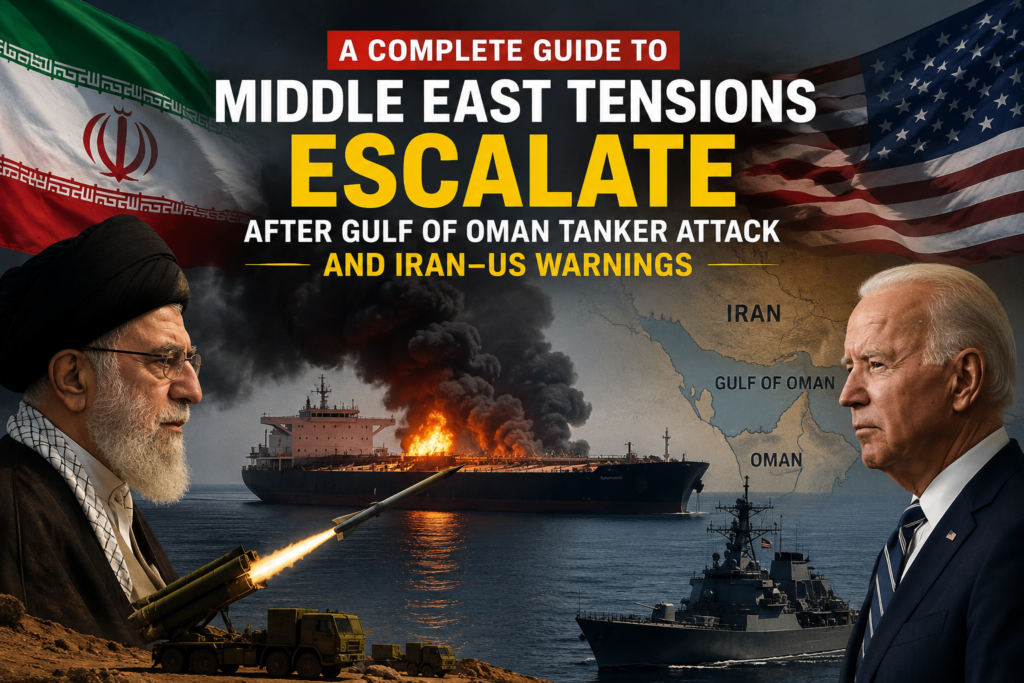
The waters near the Strait of Hormuz caught fire again this week — literally. Early Tuesday morning, a tanker traveling off the coast of Oman was struck by a projectile, igniting flames on its port side and sending a fresh jolt through global energy markets. This is the essence of A Complete Guide to How Middle East Tensions Escalate After Gulf of Oman Tanker Attack and Iran–US Warnings: a single incident at sea, layered onto months of fragile diplomacy, that threatens to unravel a truce many hoped would hold.
If you’ve been trying to make sense of the headlines — “tanker hit,” “Iran warns U.S.,” “Strait of Hormuz on edge” — you’re not alone. The story is complicated because it isn’t really about one ship. It’s the latest chapter in a regional war that began in February 2026, paused uneasily in June, and is now being tested again. This guide walks through exactly how we got here, what happened in the Gulf of Oman this week, why Iran–US warnings are escalating in parallel, and what it all means for oil markets, shipping, and the broader Middle East.
Understanding A Complete Guide to How Middle East Tensions Escalate After Gulf of Oman Tanker Attack and Iran–US Warnings requires stepping back before stepping forward — so let’s start with the background that makes this week’s tanker strike so consequential.

Section 1: The Road to This Week — How We Got Here
1.1 A War That Started With a Single Night of Strikes
To understand why a tanker attack off Oman can move oil prices and rattle NATO leaders, you have to go back to February 28, 2026. That night, the United States and Israel launched a coordinated campaign — codenamed Operation Epic Fury by Washington and Operation Roaring Lion by Israel — against Iranian military and nuclear infrastructure. <cite index=”10-1″>Hostilities broke out after US–Israeli airstrikes killed several Iranian officials, including Supreme Leader Ali Khamenei</cite>, an outcome that instantly transformed a limited strike campaign into full-scale war.
The trigger, according to multiple accounts, was the collapse of nuclear negotiations between Washington and Tehran that had been underway since 2025. <cite index=”12-1″>The initial wave of strikes killed Iran’s Supreme Leader along with dozens of other officials, and separately killed roughly 170 people when a missile struck a girls’ school near a naval base in Minab, close to Bandar Abbas</cite> — a tragedy that hardened Iranian public anger even among those who welcomed the fall of senior regime figures.
Iran’s retaliation was immediate and wide-reaching. <cite index=”10-1″>Iran responded with a series of missile and drone attacks against Israel, US-aligned Arab countries, and US military bases across the region, while simultaneously moving to block the Strait of Hormuz</cite>. Within days, the conflict had pulled in additional actors: Hezbollah opened a front from Lebanon, and Gulf states including the UAE, Saudi Arabia, and Kuwait found themselves exchanging fire with Iranian-aligned forces after being targeted themselves.
1.2 Why the Strait of Hormuz Became Ground Zero
The Strait of Hormuz is barely 21 miles wide at its narrowest point, yet it is arguably the single most important waterway in the global economy. Before the war, roughly a quarter of the world’s seaborne oil and a fifth of its liquefied natural gas moved through this chokepoint between Iran and Oman. Iran has understood this leverage for decades, and once the February strikes began, it used the strait as both a weapon and a bargaining chip.
According to Wikipedia’s tracking of the conflict, <cite index=”23-1″>shipping traffic through the Strait of Hormuz has been largely blocked by Iran since February 28, 2026, when the IRGC issued warnings forbidding passage, boarded and attacked merchant ships, and laid sea mines in the strait</cite>. The disruption was staggering: tanker traffic collapsed to almost nothing within days, and by late March, Iran had formally declared the strait closed to any vessel connected to the United States, Israel, or their allies.
The economic fallout was described by the World Bank as historic. <cite index=”22-2″>Global oil supply crashed by 10.1 million barrels per day in March due to attacks on energy infrastructure and restrictions on tanker traffic, and Brent crude prices jumped roughly 65% — about $46 per barrel — by the end of that month, marking the largest monthly rise on record</cite>. For ordinary consumers from Tokyo to Rotterdam, this meant fuel shortages, rationing, and sticker shock at the pump — a real-world example of how a regional military conflict can ripple through household budgets worldwide.
1.3 The Fragile Path to a Truce
Fighting didn’t stop cleanly. A short-lived ceasefire in early April broke down after renewed Israeli action in Lebanon and Iran’s refusal to reopen the strait, prompting the United States to impose its own naval blockade on Iranian ports in mid-April. It wasn’t until mid-June that the two sides reached a breakthrough: a memorandum of understanding to end the war, signed by President Trump and Iranian President Masoud Pezeshkian in separate ceremonies. <cite index=”10-2″>The dual blockade was lifted the following day, but tensions escalated again, and despite multiple clashes, the US and Iran agreed on June 28 to cease their exchange of attacks</cite>.
This is the backdrop that matters most for understanding this week’s events: the memorandum ended large-scale combat, but it never resolved the underlying disputes — over Iran’s nuclear program, over who controls passage through the strait, and over whether Iran can charge tolls to ships transiting near its waters. That unfinished business is exactly what boiled over this week.
Section 2: What Happened in the Gulf of Oman This Week
2.1 The Tanker Attack, Step by Step
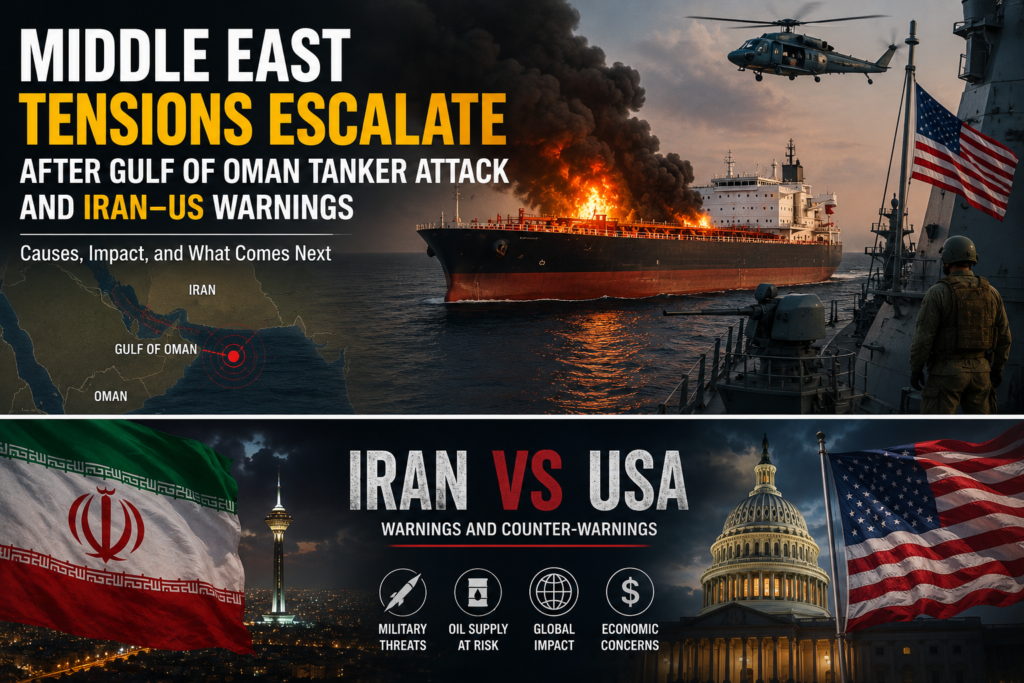
Early Tuesday, July 7, a vessel traveling south out of the Strait of Hormuz toward the Gulf of Oman was struck by an unidentified projectile. According to the UK Maritime Trade Operations Centre, the incident occurred roughly eight nautical miles east of Limah, Oman. <cite index=”5-1″>UKMTO reported the tanker had been hit by an unknown projectile on its port side, causing a fire, while traveling southbound, and said there was no environmental impact from the strike as authorities investigated</cite>.
Details about the vessel itself emerged gradually and, at times, inconsistently. <cite index=”1-1″>Qatar’s Foreign Ministry identified the ship as the Qatari-flagged Al-Rakiyat, reportedly struck while passing near the strait</cite>, while <cite index=”1-1″>The Wall Street Journal, citing an unnamed US official, reported that Iran’s Revolutionary Guard Corps had fired at two commercial ships near the strait</cite>, and <cite index=”1-1″>Axios similarly reported, citing unnamed US officials, that Iran had fired missiles at commercial vessels transiting the waterway</cite>. Iranian state media offered its own version: <cite index=”2-1″>Iranian television said the liquefied natural gas tanker came under attack after ignoring warnings</cite> — implying, without directly confirming, Iranian responsibility.
No official claim of responsibility has come from Tehran. As of this writing, no casualties have been reported, and the fire does not appear to have caused a wider environmental incident. But the ambiguity itself is part of the story — nobody transiting the strait right now can be fully certain who fired, why, or whether they’ll be next.
2.2 Why This Particular Route Matters
One detail is key to understanding the attack: the tanker appears to have been using what’s known as the “Omani route” — a path that hugs the coast of Oman rather than passing closer to Iranian waters. This route was developed specifically to give commercial shipping a safer alternative during the war. Iran, however, has never fully accepted it. <cite index=”3-1″>Iran’s joint military command warned last Thursday that all oil tankers moving through the strait must use its approved routes, and that any interference by U.S. forces in the strait “will be met with a rapid and decisive reaction”</cite>.
An analyst interviewed by Al Jazeera offered an alternative explanation worth noting for balance: <cite index=”2-2″>the tanker may have strayed into an area where Iranian teams were conducting mine-clearing operations, meaning its movement could have been misread as a threat rather than deliberately targeted</cite>. This doesn’t resolve the mystery, but it illustrates how easily miscalculation — not just intent — can trigger escalation in these waters.
2.3 The Timing Couldn’t Be More Sensitive
Context is everything here. The attack landed during a week already thick with tension. <cite index=”3-2″>Iran was in the middle of a funeral procession for former Supreme Leader Ayatollah Ali Khamenei, with hundreds of thousands of mourners walking toward Jamkaran Mosque near Qom</cite>, and <cite index=”4-3″>some mourners were seen chanting for the deaths of both President Trump and Israeli Prime Minister Benjamin Netanyahu</cite> — a visible sign that public appetite for reconciliation with Washington remains thin, whatever the diplomats are negotiating behind closed doors.
Simultaneously, President Trump was traveling to Turkey for the NATO summit in Ankara, where Gulf security was already on the agenda. <cite index=”1-1″>The reported attack occurred hours before Trump departed for the summit</cite>, and once there, <cite index=”4-2″>he told reporters he was “very disappointed” with how NATO allies had responded to the war the U.S. and Israel launched against Iran</cite>. The optics of a tanker fire breaking out just as the American president lands among allied leaders only amplified the story’s urgency.
Section 3: Iran–US Warnings — The War of Words Behind the War of Ships
3.1 What Each Side Is Actually Saying
The maritime incident hasn’t happened in a vacuum — it’s unfolding alongside a sharpening exchange of rhetoric between Washington and Tehran. On Monday, before the tanker was hit, President Trump delivered a blunt message. <cite index=”3-2″>He warned Iran that they would “make a deal or we’re going to finish the job,” adding that he’d “rather make a deal” because he didn’t “want to affect 91 million people”</cite> — a reference to Iran’s population and, implicitly, the human cost of renewed full-scale war.
Iran’s military leadership answered in kind days earlier with its own red line. As noted above, <cite index=”3-1″>Iran’s joint military command declared that interference by U.S. forces in the strait would be met with a “rapid and decisive reaction”</cite>. Reading these two statements side by side, it’s easy to see why observers describe the current moment as a fragile equilibrium: both sides are signaling willingness to return to combat while also insisting they’d prefer not to.
3.2 The Stalled Negotiations
Diplomacy hasn’t formally collapsed, but it has stalled. <cite index=”1-1″>Tehran paused its fragile negotiations with the U.S. aimed at reaching a lasting deal during the multi-day funeral for Khamenei</cite>, and <cite index=”20-2″>indirect talks that concluded the previous week ended without meaningful progress toward a lasting peace agreement</cite>. Whether talks resume once mourning rites conclude — and whether this week’s tanker incident makes Tehran’s negotiators more or less willing to compromise — is arguably the single biggest open question hanging over the region right now.
3.3 A History of Threats That Escalated Into Action
Skeptics might ask whether Iranian warnings are just rhetoric. The historical record this year suggests otherwise. In early June, <cite index=”8-2″>Iran said it launched warning missiles and drones toward American warships in the Gulf of Oman, a claim the U.S. rejected as a serious violation of the truce</cite>. Weeks later, U.S. forces demonstrated they were equally willing to act rather than just threaten: <cite index=”9-1″>American forces issued multiple warnings, which were ignored, before enforcing blockade measures by firing 20mm cannon rounds at the rudder of an Iranian-flagged tanker attempting to break the blockade from the Gulf of Oman</cite>. In other words, both governments have already shown they will translate warnings into action when they believe the other side has crossed a line — which is precisely why this week’s rhetoric is being read so seriously by markets, diplomats, and regional governments alike.
Section 4: The Ripple Effects — Oil Markets, Shipping, and the Global Economy
4.1 How Markets Reacted This Time
One of the clearest ways to measure “how Middle East tensions escalate” in real time is to watch the price of oil. This week’s reaction was immediate, if measured. <cite index=”20-2″>Brent crude futures rose about 50 cents to $72.49 a barrel on the news, while U.S. West Texas Intermediate futures gained 39 cents to $68.94</cite>, having closed at multi-month lows just before the attack. Analysts framed the move as a sign of how <cite index=”20-1″>the incident reaffirmed the fragility of the U.S.-Iran interim peace agreement</cite>, rather than a sign that markets expect an immediate return to full-scale war.
That relatively contained reaction is itself informative. It suggests traders have grown somewhat accustomed to intermittent Strait of Hormuz incidents after months of volatility, and are now differentiating between isolated flare-ups and a full collapse of the truce. Still, the underlying vulnerability hasn’t gone away — a point underscored by the World Bank’s own outlook: <cite index=”22-3″>oil prices are expected to remain high, with Brent averaging $86 a barrel in 2026, and could range as high as $95 to $115 a barrel if hostilities re-escalate or new obstacles to regional oil flows emerge</cite>.
4.2 The Practical Cost to Global Shipping
Beyond price charts, the human and logistical toll has been severe. According to Brookings’ ongoing analysis of the conflict, <cite index=”21-2″>insurance for vessels transiting the strait has become unavailable or prohibitively expensive, and seafarers have grown unwilling to make the journey — effectively closing the strait even without a formal blockade</cite>. At the peak of the disruption, the scale of stranded shipping was enormous: <cite index=”23-1″>the International Maritime Organization reported in late April that roughly 20,000 mariners and 2,000 ships were stranded in the Persian Gulf</cite> as a direct result of the closure.
Even the mechanics of who gets to sail have become contested and, in places, monetized. Brookings notes a striking detail: <cite index=”21-4″>reports suggest the IRGC has been charging around $1 per barrel of oil for safe passage, which for a very large crude carrier could mean roughly $2 million per transit</cite> — raising fears that other nations controlling their own maritime chokepoints, from the Strait of Malacca to the Strait of Gibraltar, could see this as a precedent worth emulating.
4.3 A Practical Example: The “Omani Route” Gamble
Here’s a concrete, real-world example of how these tensions play out for individual shipping companies. Since the June memorandum was signed, more vessels have cautiously resumed transits, many choosing the Omani-hugging route in hopes of staying clear of Iranian patrol areas. That calculation seemed reasonable — until this week. The tanker struck on Tuesday was reportedly using exactly that route, and Iran had signaled displeasure with it just days earlier by deploying patrol boats. For any shipping company weighing whether to resume Gulf transits, this incident is a vivid illustration of the risk calculus: a route considered “safer” one week can become the site of the next incident the next.
Section 5: Regional and Diplomatic Fallout
5.1 Gulf States Caught in the Middle
Oman, whose coastline was the site of this week’s attack, has spent much of the past year trying to balance two roles: neutral mediator between Washington and Tehran, and host to the “safe” shipping corridor that Iran keeps disputing. That balancing act is becoming harder to sustain. Earlier in the war, Oman itself was directly targeted — <cite index=”8-1″>Iran launched a series of drone strikes on sites in Oman starting February 28, 2026, initially hitting the ports of Duqm and Salalah, and the attacks across Oman ultimately killed 18 people and injured 23 others</cite>. Given that history, a fresh tanker strike so close to Omani waters is unlikely to be received calmly in Muscat.
5.2 NATO’s Uneasy Position
The timing of this week’s incident, landing just as leaders gathered in Ankara, put Gulf security squarely on the summit agenda — and exposed real friction between Washington and its allies. <cite index=”4-2″>Trump told reporters he was “very disappointed” in NATO’s response to the war the U.S. and Israel had launched against Iran</cite>, a comment that suggests Washington feels undersupported by European partners even as it seeks their backing for continued pressure on Tehran.
5.3 The Legal and Political Debate Continues
Separately from the battlefield, a quieter fight has been playing out over whether the initial February strikes were even lawful under international law. The U.S. State Department has defended the operation as an act of collective self-defense on Israel’s behalf, while international law scholars remain divided. Regardless of where one lands on that debate, it’s worth understanding as part of the full picture: <cite index=”18-3″>critics have argued the strikes were inconsistent with the UN Charter, while the U.S. government maintains its actions fall within recognized legal contours for self-defense</cite>. This unresolved legal question continues to shape how other nations — from the UK to Canada — calibrate their own level of involvement or support.
Section 6: Best Practices for Following This Story (And Avoiding Common Mistakes)
Given how fluid and contested the reporting is, here are some practical tips for anyone trying to track this crisis responsibly.
Do treat early reports with caution. In nearly every incident this year, initial claims from Iranian state media, U.S. officials, and independent monitors like UKMTO have diverged — sometimes significantly — before a clearer picture emerges. Waiting a news cycle before drawing conclusions about “who did it” is usually wise.
Don’t assume a market move means the war has resumed. As this week showed, oil prices can rise modestly on a single incident without signaling a full return to hostilities. Watch for pattern, not just headline.
Do pay attention to which route or region is affected. Attacks near Omani-controlled waters carry different diplomatic weight than attacks closer to Iranian territorial waters, since they implicate a third country that has tried to stay neutral.
Don’t ignore the human cost. It’s easy to focus on oil prices and geopolitics, but real people — mariners, dockworkers, residents near strike zones — bear the direct consequences of every escalation.
Do track the diplomatic calendar. Iran’s mourning period for Khamenei, NATO summits, and scheduled negotiation rounds all shape when and why incidents are more or less likely to occur.
Don’t expect a quick resolution. The underlying disputes — Iran’s nuclear program, control of the strait, and mutual distrust after a war that killed thousands — are not close to being settled by a single memorandum of understanding.
Section 7: What Comes Next — Expert-Informed Outlook
Predicting the exact trajectory of this crisis is inherently uncertain, but a few reasonable scenarios are worth outlining based on the pattern established since February.
Scenario one: contained flare-up. The tanker attack is treated as an isolated incident, both sides avoid direct retaliation, and negotiations resume once Khamenei’s funeral concludes. This is roughly consistent with how markets reacted this week — real concern, but not panic.
Scenario two: tit-for-tat escalation. Similar to the pattern seen in March and April, one incident prompts a retaliatory strike, which prompts a further response, gradually eroding the June memorandum without either side declaring the truce dead.
Scenario three: return to open conflict. Given the size of the U.S. military presence still in the region, and the fact that Iran’s new leadership under Ayatollah Mojtaba Khamenei is untested, a serious miscalculation — such as U.S. or allied casualties from a tanker strike — could reignite large-scale hostilities.
Whichever path unfolds, the throughline of A Complete Guide to How Middle East Tensions Escalate After Gulf of Oman Tanker Attack and Iran–US Warnings is this: the region’s fate now hinges less on formal declarations of war or peace, and more on how each side manages a long series of smaller, ambiguous incidents — any one of which could either fade quietly or become the spark for something much larger.
Section 8: Frequently Asked Questions
Why does a single tanker attack matter so much to the global economy? Because of geography, not size. The Strait of Hormuz is the only sea route out of the Persian Gulf, meaning any oil or gas produced by Saudi Arabia, Iraq, the UAE, Kuwait, and Qatar has to pass through this narrow corridor to reach world markets. Even a strike on a single vessel raises the “risk premium” that insurers, shipowners, and traders attach to the entire route — which is why prices move on incidents that, in isolation, cause no casualties.
Is the U.S.–Iran war technically over? Not in a formal, legally binding sense. What exists is a memorandum of understanding, signed in mid-June, intended to pause hostilities while both sides negotiate a lasting settlement. A memorandum is not a peace treaty — it is closer to a ceasefire framework, which is why analysts continue to describe the current situation as an “interim peace agreement” rather than a resolved conflict. That distinction explains why incidents like this week’s tanker strike are described as testing the truce, rather than as violations of a war-ending treaty.
Who is actually in control in Tehran right now? Following the killing of Ayatollah Ali Khamenei in February, his son, Ayatollah Mojtaba Khamenei, was named Iran’s new Supreme Leader. His leadership is still relatively new and untested in a crisis of this scale, which adds a layer of unpredictability. Analysts watching Iran’s internal politics note that hardline factions within the Islamic Revolutionary Guard Corps may hold significant sway over decisions relating to the Strait of Hormuz, independent of what Iran’s civilian negotiators say in formal talks.
What role does Oman play in all of this? Oman has positioned itself as the primary back-channel mediator between Washington and Tehran throughout the crisis, hosting several rounds of indirect talks. At the same time, its coastline and territorial waters have repeatedly become flashpoints — both as the site of direct Iranian strikes earlier in the war and, this week, as the location of the latest tanker incident. That dual role, mediator and battleground, is one of the more delicate dynamics in the entire regional picture.
Could this escalate into a wider war involving other countries? It already has, to a degree. Hezbollah’s entry into the conflict from Lebanon, and direct clashes between Iran and Gulf states including Saudi Arabia, the UAE, and Kuwait, show that containment has already partially failed once. Whether this week’s incident triggers a similar widening depends heavily on whether either Washington or Tehran chooses direct retaliation versus continued restraint.
What should everyday consumers expect from all this? The most direct effect on ordinary households is at the pump and in shipping-dependent goods. Even modest, contained incidents like this week’s tend to nudge fuel prices upward temporarily. A larger disruption — a renewed blockade, for instance — would have a much bigger and more immediate effect on global fuel costs and the price of goods that rely on maritime shipping through the Gulf.
Section 9: A Timeline of Key Milestones
Reviewing the sequence of events side by side helps make sense of how a single tanker strike fits into a much longer arc:
- February 28, 2026 — The U.S. and Israel launch Operation Epic Fury, killing Iran’s Supreme Leader Ali Khamenei and dozens of officials; Iran retaliates with missile and drone strikes across the region and begins restricting the Strait of Hormuz.
- Early March 2026 — Iran declares the strait effectively closed to vessels linked to the U.S., Israel, and their allies; tanker traffic collapses; oil prices post their largest monthly jump on record.
- April 8–13, 2026 — A two-week ceasefire begins but comes under strain after renewed fighting in Lebanon; the U.S. responds by imposing a naval blockade on Iranian ports.
- June 14–17, 2026 — A memorandum of understanding to end the war is announced and formally signed by President Trump and Iranian President Masoud Pezeshkian; the dual blockade is lifted the next day.
- June 28, 2026 — Despite renewed clashes, the U.S. and Iran agree to cease their exchange of attacks, reaffirming the fragile truce.
- Early July 2026 — Iran holds a multi-day state funeral for Khamenei, drawing large crowds and vocal anti-U.S., anti-Israel sentiment.
- July 6–7, 2026 — President Trump warns Iran to “make a deal” or face renewed military action; a tanker is struck by a projectile near Limah, Oman, reigniting fears the truce may not hold; oil prices tick higher as Trump arrives in Ankara for the NATO summit.
This timeline underscores a pattern worth remembering: nearly every diplomatic step forward in this conflict has been followed, within weeks, by a fresh maritime or military incident that tests whether it will actually hold.
Conclusion
This week’s tanker fire in the Strait of Hormuz is a small, contained incident in isolation. No lives were reported lost. No formal blockade has been reimposed. Oil prices ticked up, rather than spiked. But context transforms the story: it lands amid a fragile, unresolved truce; a funeral procession charged with calls for vengeance; presidential warnings about “finishing the job”; and Iranian military declarations promising a “rapid and decisive reaction” to any perceived U.S. interference.
That’s the real lesson of A Complete Guide to How Middle East Tensions Escalate After Gulf of Oman Tanker Attack and Iran–US Warnings — escalation in this region rarely arrives as a single dramatic event. It builds through a sequence of smaller sparks, each one testing whether the last truce still holds. Understanding that pattern — the history behind it, the incentives driving both Washington and Tehran, and the economic stakes for the rest of the world — is the best tool available for making sense of whatever headline comes next.
As always with a live, fast-moving conflict, details are still emerging and official confirmations remain pending on several fronts. Readers following this story should expect updates, corrections, and new developments in the days ahead.