
Introduction
Few military organizations anywhere in the world wear as many hats as Iran’s Islamic Revolutionary Guard Corps. It is, at once, an army, a navy, an air and missile force, an intelligence service, a business conglomerate, and — depending on who you ask — the real power behind Iran’s government. Western officials call it a terrorist organization. Iranian officials call it the guardian of their revolution. Both descriptions, as it turns out, are pointing at the same institution from different angles.
If you’ve been following recent headlines about Gulf tanker attacks, U.S.-Iran tensions, or the war that reshaped Iran’s leadership earlier this year, you’ve almost certainly seen the acronym IRGC attached to nearly every development. This guide breaks down exactly what the IRGC is, how it came to hold so much power, how it’s structured, and what its role looks like today — using verified reporting rather than speculation.
What Is the IRGC, Exactly?
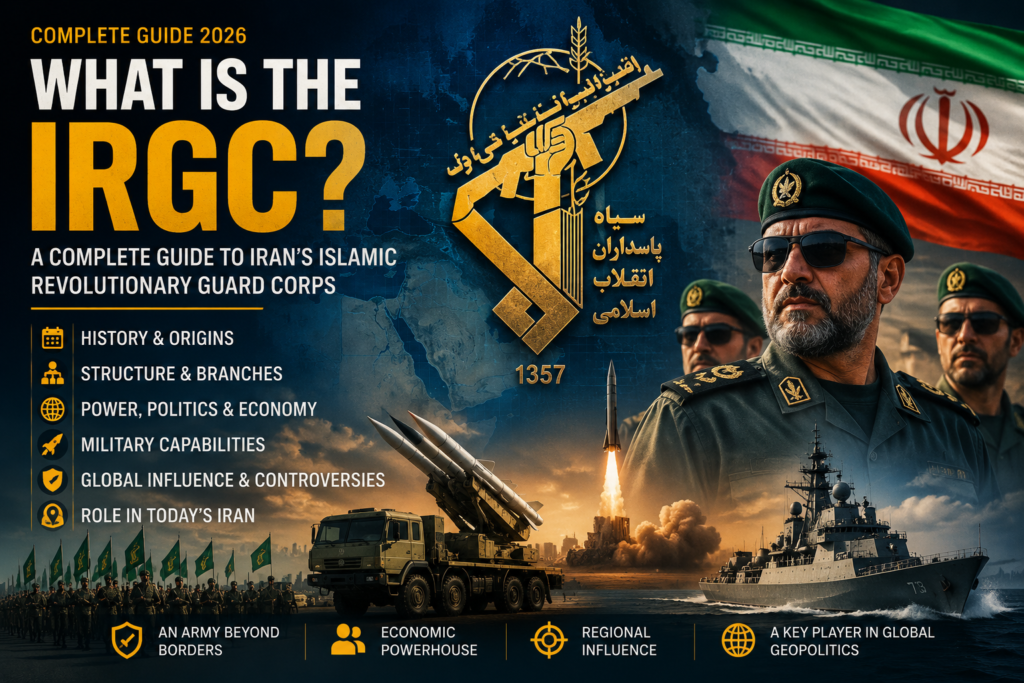
The Islamic Revolutionary Guard Corps — known in Iran as Sepah or Pasdaran — is one of two main branches of Iran’s armed forces, alongside the regular military, or Artesh. But calling it simply a “military branch” undersells what it actually does. <cite index=”16-1″>The IRGC consists of five service branches: Ground Forces, Aerospace Force, Navy, Quds Force, and Basij, and it’s led by a commander-in-chief who is appointed by and reports directly to Iran’s Supreme Leader</cite>.
Unlike Iran’s regular army, which is constitutionally tasked with defending the country’s borders in a conventional sense, <cite index=”17-2″>the IRGC answers directly to the Supreme Leader, and its command structure bypasses the elected president entirely</cite>. That single design choice explains much of what follows in this guide — because an institution that reports only to the country’s top cleric, rather than to any civilian government body, tends to accumulate power differently than a conventional military does.
Section 1: The History of the IRGC
1.1 Born From Revolution, Built on Distrust
To understand why the IRGC exists at all, you need to go back to February 1979, when Iran’s centuries-old monarchy collapsed and Ayatollah Ruhollah Khomeini returned from exile to lead a new Islamic Republic. The new leadership inherited the Shah’s old army — and didn’t trust it.
<cite index=”21-2″>Every revolution that seizes state power faces the same problem: the government it just took over comes with a pre-existing military built to serve the previous regime, and that military might switch loyalties, or might not, or might simply wait for a chance to switch back</cite>. Khomeini’s answer was to build an entirely new force loyal only to the revolution.
<cite index=”20-1″>On May 5, 1979, Khomeini ordered the formation of the IRGC out of roughly 700 revolutionaries who had trained in Lebanon</cite>. <cite index=”19-1″>In practice, this meant consolidating four separate Islamist paramilitary groups that had been active before and during the revolution into a single unified organization</cite>. <cite index=”22-1″>Its early mandate was to defend the revolution, suppress internal dissent, and promote the ideology of the new Islamic order</cite>.
1.2 The Iran–Iraq War: From Militia to Military Power
The IRGC’s transformation from scrappy militia to serious military institution happened on the battlefield. <cite index=”18-1″>Its role, size, and stature expanded significantly during the Iran-Iraq War, which ran from 1980 to 1988, as it grew in structure and complexity while receiving strong political backing</cite>. <cite index=”22-2″>Because Iraq’s better-equipped, better-trained forces invaded in 1980, the IRGC leaned on ideological fervor and unconventional tactics rather than conventional firepower — including deploying young, largely untrained Basij volunteers in massed infantry assaults</cite>.
By the war’s end, the IRGC was no longer a ragtag group of loyalists. <cite index=”16-2″>It had emerged from that war as a largely independent organization that the clerical leadership had come to rely on</cite>.
1.3 Peacetime Expansion Into Politics and Business
With the war over, the IRGC didn’t shrink — it diversified. <cite index=”33-3″>Under President Akbar Hashemi Rafsanjani’s postwar reconstruction era, the IRGC expanded into the economy, and the creation of the Khatam al-Anbiya Construction Headquarters marked the beginning of its transformation into a major economic actor</cite>.
Its political footprint grew in parallel. <cite index=”18-2″>The IRGC began intervening more directly in political affairs during President Mohammad Khatami’s reform-minded presidency from 1997 to 2005, largely to counter his agenda, and its political representation expanded further under Mahmoud Ahmadinejad’s presidency from 2005 to 2013</cite> — a former IRGC-linked official himself, who appointed numerous Guards figures to senior government posts.
By 2026, one long-form historical account summarized the scale of that transformation bluntly: <cite index=”21-1″>what started as a collection of paramilitary groups fused under a single command had, by the 1980s, developed its own ground forces, navy, air force, and intelligence apparatus; by the 2000s it controlled Iran’s ballistic missile program; and by 2026, Reuters was describing it as a state-within-a-state, complete with its own economy, media empire, foreign policy apparatus, and construction company employing 25,000 engineers</cite>.
Section 2: How the IRGC Is Structured
2.1 The Five Branches
As noted above, the IRGC is organized into five distinct service branches, each with a specific function:
- Ground Forces — the largest component, historically focused on internal order and territorial defense, though it has increasingly taken on expeditionary roles beyond Iran’s borders.
- Navy — <cite index=”16-1″>now Iran’s primary force exercising operational control over the Persian Gulf, functioning as a de facto coast guard</cite>, and the branch most directly involved in confrontations near the Strait of Hormuz.
- Aerospace Force — controls Iran’s strategic missile arsenal, including its ballistic missile program.
- Quds Force — the IRGC’s external operations and expeditionary arm, examined in more detail below.
- Basij — a mass-mobilization militia integrated into the IRGC’s command structure.
2.2 Size and Budget
Personnel estimates for the IRGC vary depending on the source and what is being counted. <cite index=”16-1″>Wikipedia’s tracking places active personnel at approximately 125,000 as of 2024</cite>, while <cite index=”28-2″>a 2026 RFE/RL report describes the force as having upward of 180,000 troops under its command</cite>. A 2026 analysis suggests the picture is murkier still: <cite index=”33-2″>there is no single reliable, up-to-date figure for total IRGC personnel, though official statements indicate its training and mobilization capacity — including coordination units, ideological-political structures, and Basij networks — can exceed 220,000 individuals annually</cite>.
Funding has surged alongside regional tensions. <cite index=”16-1″>In 2023, Iran’s total military expenditure was estimated at $10.3 billion, with the IRGC receiving roughly 37% of that, or about $3.8 billion; by 2024, the total military budget had risen to approximately $16.7 billion</cite>, and <cite index=”16-1″>in 2025 the Iranian government proposed a 200% increase in military spending, directing more than half of its oil and gas export revenues — an estimated €12 billion — toward the armed forces, including the IRGC</cite>.
2.3 The Quds Force: Iran’s Expeditionary Arm
If the IRGC’s other branches primarily look inward, the Quds Force looks outward. <cite index=”17-3″>It emerged as the IRGC’s de facto external affairs branch, developing ties with armed groups across Afghanistan, Iraq, Lebanon, the Palestinian territories, Yemen, and beyond — providing training, weapons, money, and military advice to help project Iranian power abroad</cite>.
This network is often described by Tehran as an “axis of resistance.” <cite index=”17-1″>The IRGC supports militant groups across Iraq, Lebanon, the Palestinian territories, Syria, and Yemen, with the stated aim of reducing Western and Israeli influence in the region</cite>. Some of these affiliated groups act with real independence, but Iran views them collectively as aligned against a common set of adversaries.
A concrete, well-documented example: <cite index=”33-4″>Quds Force elements helped establish Hezbollah in Lebanon shortly after the Iran-Iraq War began, later supported the Syrian government during its civil war, became involved in Iraq’s internal power struggles including operations against ISIS, and trained Houthi forces in Yemen</cite>. <cite index=”33-4″>According to international media reporting, the IRGC has also reportedly overseen the delivery of drones and military support to Russia for its war in Ukraine</cite> — illustrating how far beyond the Middle East its expeditionary reach now extends.
2.4 The Basij: A Militia for Mass Mobilization
The Basij is the IRGC’s volunteer, mass-mobilization component. <cite index=”16-1″>Originally a separate organization, the Basij was founded by Khomeini’s order in November 1979, merged into the IRGC’s broader structure in 1980, and folded into its Ground Forces in 2008</cite>.
Its role has always combined military and social functions. <cite index=”20-2″>Khomeini created the Basij as a militia of pious youth followers — some of whom had fought against the Shah — initially to help manage property confiscated from the former elite and royal family</cite>. In more recent decades, it has become the IRGC’s primary domestic enforcement tool, discussed further below.
Section 3: What Does the IRGC Actually Do?
3.1 A Constitutional Mandate to “Guard the Revolution”
The IRGC’s legal foundation is deliberately broad. <cite index=”19-2″>Article 150 of Iran’s constitution defines the IRGC’s purpose as being to “guard the Revolution and its achievements”</cite> — a phrase vague enough to justify an enormous range of activity, from conventional defense to domestic policing to economic control.
<cite index=”16-1″>Whereas Iran’s regular army protects the country’s sovereignty in a traditional capacity, the IRGC’s constitutional mandate is instead to ensure the integrity of the Islamic Republic itself — commonly interpreted to include preventing foreign interference, thwarting potential military coups, and crushing movements considered ideologically threatening to the revolution’s legacy</cite>.
3.2 Domestic Security and Protest Suppression
Domestically, the IRGC and its Basij militia function as a central pillar of internal security. <cite index=”23-4″>They have been identified as either the primary force or a key supporting force behind the suppression of numerous protest waves in Iran, from student and labor demonstrations to the nationwide unrest that followed Mahsa Amini’s death and beyond</cite>.
This role has drawn intense international scrutiny in recent years. Nationwide protests that began in late 2025 over economic grievances evolved into one of the most serious challenges the Islamic Republic has faced. <cite index=”25-2″>The U.S.-based Human Rights Activists News Agency reported that at least 6,373 people — including 5,993 identified as protesters — were killed during the crackdown, with fears that the true toll could be higher</cite>. It was this crackdown, more than any single military action, that prompted a major shift in how Western governments treat the organization — covered in the next section.
3.3 Economic Power
The IRGC’s reach into Iran’s economy is difficult to overstate, even if its full scale is hard to quantify precisely. <cite index=”20-1″>The organization controls extensive economic assets across all of Iran’s major economic sectors, though the total value of this portfolio is not publicly known</cite>. <cite index=”24-3″>It maintains a significant footprint in construction, energy, telecommunications, and infrastructure development, managing substantial financial resources through a network of affiliated companies and foundations</cite> — a legacy of the Khatam al-Anbiya Construction Headquarters established during the postwar reconstruction era.
This economic autonomy matters strategically: it means the IRGC isn’t solely dependent on the state budget, which insulates it from at least some forms of civilian political pressure and gives it independent leverage within Iran’s power structure.
Section 4: International Terrorist Designations
4.1 The U.S. Designation
<cite index=”25-1″>The United States labeled the IRGC a Foreign Terrorist Organization in April 2019, including its Quds Force branch, and has since been joined by Argentina, Canada, and Middle East allies including Israel, Saudi Arabia, and Bahrain in similarly designating the IRGC or its Quds Force as a terror group</cite>.
4.2 The EU’s 2026 Reversal
For years, the European Union resisted formally designating the IRGC as a terrorist organization, preferring to maintain diplomatic engagement with Tehran. That changed decisively in early 2026. <cite index=”25-1″>In an unprecedented move, the 27-member European Union formally designated Iran’s IRGC as a terrorist organization at a meeting of EU foreign ministers on January 29, 2026</cite>.
The trigger was Iran’s brutal response to the late-2025 protest wave. <cite index=”26-3″>The scale and brutality of that domestic repression — mass arrests, executions, internet shutdowns, and the open use of lethal force against demonstrators — erased any remaining confidence within the EU that gradual change was possible, and unlike previous episodes, the violence could not plausibly be blamed on rogue commanders, reflecting instead a system-wide choice</cite>. <cite index=”28-1″>France, the last of the 27 member states to oppose the move, shifted its position on January 28, 2026, clearing the way for the designation</cite>.
Iran’s reaction was sharp and immediate. <cite index=”30-2″>Iran’s Foreign Ministry condemned the decision as “illegal, political and contrary to international law” and a violation of the country’s internal affairs</cite>, while <cite index=”32-2″>Iran’s Parliament Speaker, Mohammad Bagher Ghalibaf, announced a retaliatory measure designating EU member states’ armed forces as terrorist groups in turn</cite>.
4.3 Practical Consequences of the Designation
The EU listing isn’t merely symbolic. <cite index=”27-1″>Following its designation, the IRGC became subject to restrictive measures under the EU’s counterterrorism sanctions regime, including the freezing of its funds and other financial assets within EU member states, and a prohibition on EU operators making funds or economic resources available to the group</cite>. <cite index=”28-3″>One practical effect is that the designation now allows EU member states to detain any IRGC member who enters the bloc</cite>. Analysts also note a subtler consequence: <cite index=”26-4″>by creating a legal tool for secondary sanctions, the designation also raises compliance risks for non-EU companies with any ties to Iran</cite>.
Section 5: Recent Developments — The IRGC After February 2026
5.1 A Leadership Wiped Out and Rebuilt
The IRGC’s command structure has been unusually volatile in the past year, largely due to Israeli and U.S. strikes targeting its senior leadership directly. <cite index=”33-1″>Ayatollah Khamenei appointed Major General Hossein Salami to head the IRGC in 2020; Salami was killed in Israeli strikes in June 2025, and his successor, Major General Mohammad Pakpour, was killed in joint US-Israeli strikes on February 28, 2026, alongside Supreme Leader Ali Khamenei himself</cite>.
That single night of strikes reshaped Iran’s power structure in ways still being understood. <cite index=”31-1″>Subsequent reporting describes IRGC commander Ahmad Vahidi as the country’s de facto decision-maker, with the Guards now exerting significant control over Iran’s security apparatus, parliament, and strategic negotiations with Washington</cite>.
5.2 A More Decentralized, More IRGC-Centric System
Iran’s internal power structure appears to be evolving as a direct result of this leadership turnover. <cite index=”33-1″>Iran’s former security chief, Ali Larijani, reorganized the IRGC into autonomous regional headquarters that answer to the Supreme Leader’s orders only, empowered to make their own operational decisions independent of civilian leadership in Tehran</cite>. <cite index=”33-2″>With the elder Khamenei’s death, observers increasingly describe the system as less dependent on a single figure and more reliant on a network of interconnected actors with shared interests — a shift from a cleric-dominated system toward a more IRGC-centric power structure</cite>. Notably, <cite index=”33-2″>strict religious enforcement of socially restrictive policies, such as compulsory hijab rules and restrictions on nightlife, appears to have become less of a governing priority under this reshuffled system</cite>.
5.3 The Strait of Hormuz and Ongoing Maritime Tensions
Since February 2026, the IRGC Navy has been at the center of the region’s most consequential flashpoint: the Strait of Hormuz, through which roughly a fifth of the world’s oil trade normally passes. The IRGC has used naval patrol boats, drones, and — according to multiple reports — sea mines to contest passage through the strait, repeatedly testing the limits of ceasefire arrangements negotiated between Washington and Tehran throughout the spring and summer of 2026. This maritime pressure campaign is a direct, practical expression of the IRGC Navy’s stated role as Iran’s de facto coast guard and enforcer of its territorial claims in the Persian Gulf.
Frequently Asked Questions
Is the IRGC the same as Iran’s regular army? No. Iran has two separate armed forces: the regular military (Artesh), which handles conventional territorial defense, and the IRGC, which was created specifically to protect the Islamic Republic’s political and ideological system. The IRGC answers directly to the Supreme Leader, while the regular army sits within a more conventional command structure.
What is the Quds Force, and how is it different from the rest of the IRGC? The Quds Force is the IRGC’s expeditionary and intelligence branch, focused on operations outside Iran’s borders. While the IRGC’s other branches are primarily oriented toward defending Iran itself and enforcing internal security, the Quds Force builds and supports allied militant groups abroad, including Hezbollah, Hamas, and Houthi forces.
Why did the EU wait until 2026 to designate the IRGC as a terrorist organization, when the U.S. did so in 2019? The EU had long preferred a strategy of diplomatic engagement with Tehran, partly to preserve a possible channel for nuclear negotiations. That calculus shifted after the scale and brutality of Iran’s crackdown on the 2025–2026 protest movement, which EU officials described as a system-wide, not rogue, use of lethal force against demonstrators.
Who leads the IRGC today? Following the deaths of successive IRGC commanders — Hossein Salami in June 2025 and Mohammad Pakpour in February 2026 — leadership has been in flux. Reporting from mid-2026 identifies Ahmad Vahidi as a central decision-making figure within the reorganized command structure, though Iran’s post-war power arrangements continue to evolve.
Does the IRGC control Iran’s economy? It controls a substantial share of it, particularly in construction, energy, telecommunications, and infrastructure, largely through the Khatam al-Anbiya Construction Headquarters and an affiliated network of companies and foundations. The precise total value of these holdings isn’t publicly disclosed.
How large is the IRGC? Estimates vary by source and methodology. Widely cited figures place active personnel between roughly 125,000 and 180,000, while total training and mobilization capacity — including Basij networks — has been estimated at over 220,000 people annually.
Conclusion
Nearly half a century after its founding, the IRGC has become something its original architects likely never fully anticipated: not merely a loyalist militia, but a parallel state structure with its own army, navy, missile force, intelligence network, business empire, and foreign policy. Understanding today’s Iran — its internal politics, its regional alliances, and its confrontations with the United States, Israel, and Europe — is close to impossible without understanding the IRGC’s outsized role within it.
As Iran’s post-war leadership structure continues to take shape following the events of February 2026, the IRGC’s influence shows no sign of receding. If anything, recent reporting suggests it has moved even closer to the center of Iranian decision-making. For anyone following developments in the region, the IRGC isn’t a side character in the story — it is, increasingly, the story itself.