
Introduction
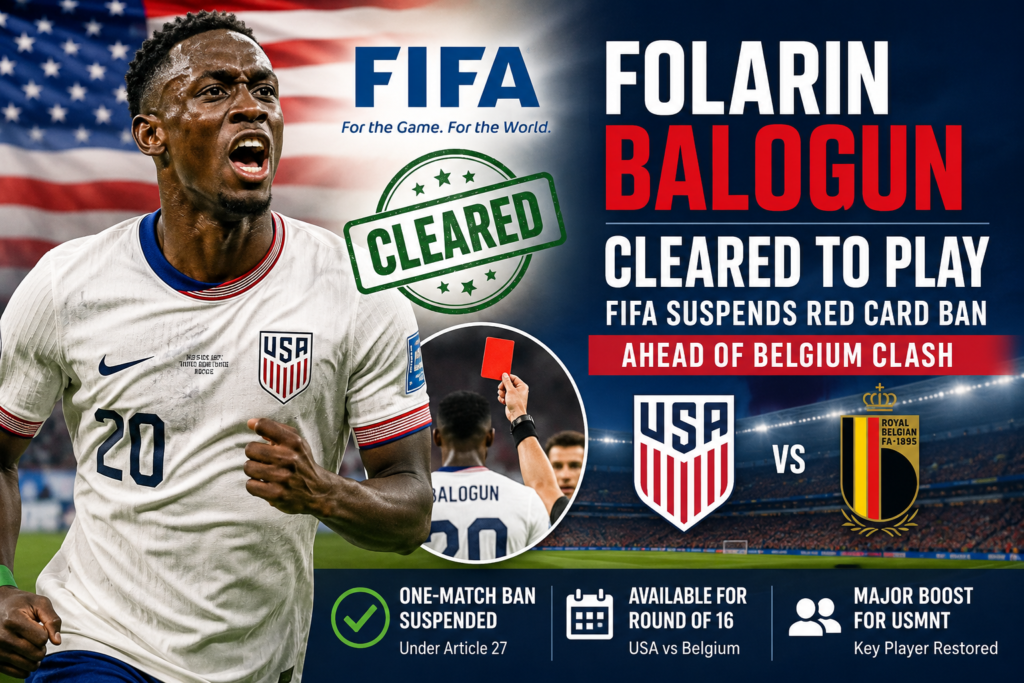
Folarin Balogun Cleared to Play: FIFA Suspends Red Card Ban Ahead of Belgium Clash has become one of the biggest football stories of the 2026 FIFA World Cup. FIFA’s unexpected decision to suspend Balogun’s one-match ban under Article 27 of the FIFA Disciplinary Code has sparked worldwide debate. The ruling gives the United States Men’s National Team (USMNT) a major boost before facing Belgium in the Round of 16 while raising important questions about FIFA’s disciplinary system.
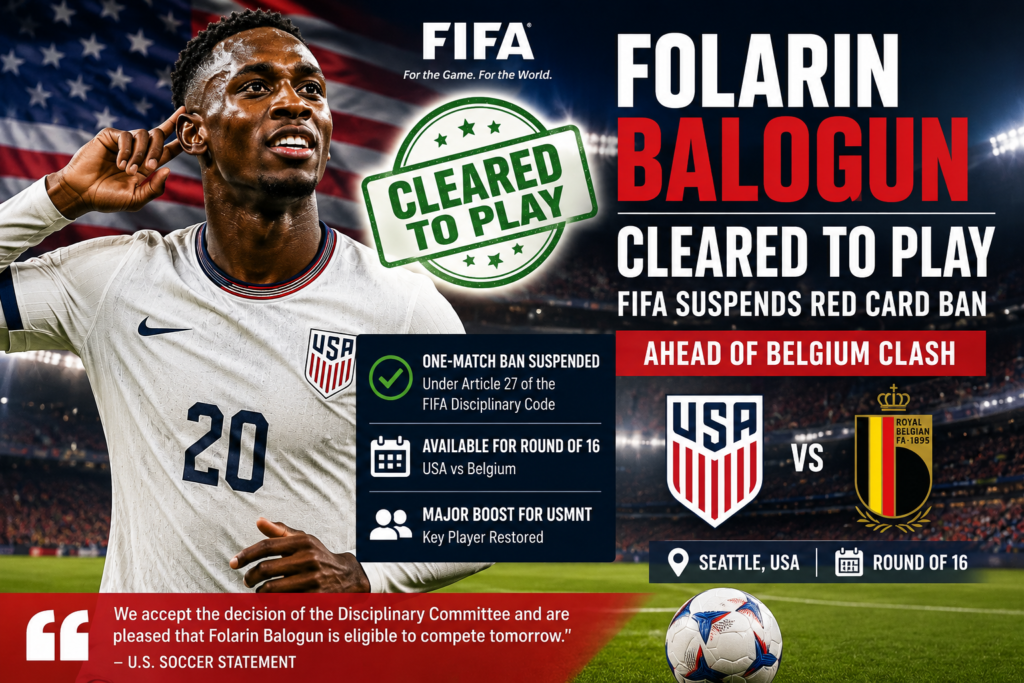
FIFA stunned the soccer world on July 5, 2026 by announcing that Folarin Balogun’s one-game World Cup suspension has been suspended – effectively clearing the United States striker to play in the Round of 16 against Belgium. Balogun had earned a red card in the USA’s win over Bosnia and Herzegovina on July 1, which by the tournament’s rules automatically would have sidelined him against Belgium. Instead, FIFA’s Disciplinary Committee invoked Article 27 of the FIFA Disciplinary Code to “suspend the implementation of the match suspension” for one year. In practical terms, the ban is on hold – Balogun will face no immediate sanction, provided he commits no similar infraction during the year-long probation. The decision, formally announced on Sunday morning, immediately drew outrage from Belgium and praise in the United States, where even former President Donald Trump publicly thanked FIFA for “reversing a great injustice!”. US Soccer promptly welcomed the news, issuing a statement that it “accept[ed] the decision of the Disciplinary Committee” and was “pleased that Folarin Balogun is eligible to compete tomorrow”.

The rapid reversal capped a whirlwind week for Balogun and the USMNT. The 25-year-old forward had been a revelation in this World Cup, scoring three goals in three starts. He opened the scoring against Bosnia to give the USA a first-half lead, before celebrating in the style of NBA legend LeBron James – a moment that even drew a congratulatory tweet from James himself. But midway through the second half Balogun was shown a straight red card by referee Raphael Claus after a VAR review of an apparent stamp on Bosnia defender Tarik Muharemović. The contact was brief – Balogun’s cleat caught Muharemović’s ankle as he shifted his weight – and many onlookers, including U.S. coach Mauricio Pochettino, felt the red card was harsh. Pochettino called it “accidental contact,” and Balogun himself insisted it was “totally unintentional” and that a yellow card would have been a fairer punishment.
Under normal World Cup regulations, however, a red card means an automatic one-game suspension. Article 10.5 of the tournament rules states that any player sent off by a direct red card (not a second yellow) “will automatically be suspended from their team’s subsequent match”. There is no appeals process for such decisions during the World Cup. In fact, FIFA’s rules explicitly declare that “referee’s decisions regarding facts connected with play… are final and not subject to appeal, unless otherwise stipulated in the FIFA Disciplinary Code”. That meant when Balogun was sent off, US Soccer assumed he would simply miss the Belgium game – a reality confirmed in subsequent reports that the US forward “will miss Monday’s Round of 16 match against Belgium”. Bayern Munich forward Christian Pulisic summed up the team’s reaction at the time: he felt Balogun’s challenge had “zero intent” and “didn’t deserve the red card”.
Yet the swift intervention of Article 27 changed the outcome. Under Article 27 of FIFA’s Disciplinary Code, the FIFA Disciplinary Committee has the power to fully or partially suspend an imposed sanction, typically by placing the offender on probation. As FIFA stated in its Sunday release (a statement published on FIFA’s website):
“By operation of Article 27 FDC, the implementation of the automatic match suspension for USA player Folarin Balogun is suspended for a probationary period of one [1] year.”
In plain language, the red-card ban has been put on hold for now. Balogun will remain eligible for the Belgium match, but the red card itself stays on his record – and if he commits “another infringement of a similar nature and gravity” within the next year, the one-game ban would be immediately enforced. FIFA’s official wording was quoted by multiple news outlets: “If Folarin Balogun commits another infringement of a similar nature and gravity during the probationary period, the suspension shall be revoked and the sanction enforced”. In effect, FIFA has granted Balogun a golden opportunity: he can play in the knockout game, but must keep his discipline in check for the rest of the year.
The U-turn was described in U.S. media as a “stunning” or “dramatic” reversal. The Athletic first reported the news on Sunday afternoon, and major outlets (AP, ESPN, FOX, etc.) quickly followed with official confirmation. Fox News detailed the key FIFA code provisions, noting that Article 27 is “part of FIFA’s disciplinary code” which allows exactly this kind of decision. The New York Times quoted the FIFA rulebook language: “the judicial body may decide to fully or partially suspend the implementation of a disciplinary measure”. Indeed, this provision has precedent. FIFA has used it in recent years: for example, in late 2025 it deferred the last two games of a three-match ban for Portugal’s Cristiano Ronaldo (following a red card in a qualifier), allowing him to start the World Cup group stage. South American stars Nicolás Otamendi and Moisés Caicedo also had one-game bans deferred in World Cup qualifiers this spring. And lore even cites Brazil legend Garrincha, who was sent off in 1962 and yet played in the final after a suspension was lifted. In modern times, however, it is extremely rare for a World Cup red card to be “suspended” in this way.
The reaction in the USA was one of elation. President Donald Trump, who has frequently expressed interest in hosting and promoting soccer, took to his social media platform to thank FIFA personally: “Thank you to FIFA for doing what was right, and reversing a great injustice!”. US Soccer’s official statement was measured: “We accept the decision of the Disciplinary Committee and are pleased that Folarin Balogun is eligible to compete tomorrow,” it said, adding that the team was now fully focused on the Belgium match. Balogun himself had been gracious when speaking to reporters Friday. He emphasized that the incident was accidental and insisted on setting a good example: “I never want to react out of anger… We have to show [fans] the correct way to handle things, even when you think it’s unjust,” he said. Now, with the ban lifted, teammates expressed relief. Defender Chris Richards described how “a lot of us thought it was AI at first” when rumors of the reinstatement circulated on social media during the team’s Sunday travel to practice. By the end of that day’s session, the locker room was celebrating. Christian Pulisic, a veteran leader on the team, said it simply “just feels right” that Balogun is back for Belgium.
By contrast, the Belgian side reacted with dismay and outrage. The Royal Belgian Football Association (RBFA) released a statement calling the FIFA decision “astonishing” and “in direct contradiction with the provisions of the FIFA World Cup 2026 Competition Regulations”. They warned they were exploring all options under the rules to protect “the legitimate rights of all participating teams” and uphold “the fundamental principles of fair play”. Indeed, on paper the World Cup regulations do state that a red card carries a one-game ban “automatically,” with no mention of discretionary suspension. Belgian officials pointed out that FIFA’s move might conflict with these competition rules. As of now, however, FIFA has not publicly reversed its ruling, and with just one day to go before the match there is no obvious mechanism for Belgium to overturn FIFA’s decision.
From a purely competitive perspective, Balogun’s return is a massive boost for the USMNT. The Dallas-born forward has been the USA’s most dangerous player, with three World Cup goals in four games. He will line up in the round-of-16 in Seattle alongside Christian Pulisic and possibly Tim Weah or Brenden Aaronson in midfield – a thrilling attacking ensemble for the home side. The Americans had been preparing mentally to play without him, but his availability now lets coach Mauricio Pochettino field what many consider his strongest possible team. In the Bundesliga, Balogun had scored 13 goals last season for Monaco, and at the World Cup he is tied for second-most goals by an American in one tournament (three, matching Landon Donovan’s 2010 haul). With the USA seeking their first World Cup quarterfinal berth since 2002, having Balogun in the lineup – especially as the match is at home in Seattle – could be decisive.
Off the field, the incident has also dominated headlines about the sport. FIFA’s unusual use of Article 27 has drawn questions from soccer experts and pundits. On TV, former referee Mark Clattenburg analyzed Balogun’s play and the rules. Clattenburg noted that while FIFA law gives officials wide latitude, the basic standards for a red card include “some speed, some force and some malice,” which he felt were absent in this case. “This was an accidental challenge,” he said, “and this doesn’t reach the requirements of a red card.” His analysis highlights why fans and commentators were divided on the original call – and why the U.S. team and some officials argued strongly that Balogun’s dismissal was too harsh. At the same time, legal experts point out that Article 27 is explicitly meant to handle situations where it is “unreasonable” to impose the penalty immediately. In a statement of principles, FIFA clarifies that “the judicial body may decide to fully or partially suspend the implementation of a disciplinary measure”, subject to probation. If this had been a case of a refereeing error (for example, if VAR mistakenly awarded a red when none was due), there would normally be no recourse. But in Balogun’s case, FIFA judges apparently concluded the spirit of the law justified the workaround – a viewpoint that has at least one precedent in the Ronaldo example.
As the USA and Belgium prepare to kick off their knockout match on Monday, all eyes will be on how Balogun’s presence shifts the game. Belgium coach Domenico Tedesco gave no public comment by kickoff time, and it’s unclear how much their game plan has changed. What is certain is that FIFA’s intervention has ensured “their leading World Cup goalscorer” will be on the field. If Balogun scores or influences the game, critics of FIFA’s move will surely have more to say about its propriety. If the USA goes down, they will lament that FIFA has bent its own rules on a team’s behalf.
Key FIFA Rules Explained: Under World Cup Regulations, teams cannot challenge a referee’s factual decisions like red cards (see Article 9.6). Any direct red in a World Cup match carries an automatic one-match ban (Article 10.5). Article 27 of FIFA’s Disciplinary Code, however, allows the appeals committee to suspend a sanction entirely or in part, substituting a probationary period of one to four years. In effect, that is what happened for Balogun: his suspension is on hold, pending good behavior. Precedents include Cristiano Ronaldo’s deferred ban in 2025 and similar one-game deferrals for Otamendi and Caicedo.
Expert Take: Many analysts see the decision as extraordinary but legally plausible. FIFA experts note that Article 27 is worded broadly enough to cover this scenario. Former USMNT captain John Harkes, speaking on Fox Sports, suggested the controversy might prompt FIFA to review its red-card appeal rules for future tournaments. Others simply applaud the result for the American team: veteran journalist Jonathan Wilson (reporting for the Guardian) wrote that the reversal gives the US “a huge boost” on the field and rewards Balogun for an otherwise exemplary campaign.
Frequently Asked Questions (FAQ):
- Can teams appeal a World Cup red card? No. FIFA’s rules explicitly bar appeals on referee judgments of facts in World Cup matches. Even if a sending-off seems unjust, the only formal recourse would come if a governing body (like the Disciplinary Committee) intervenes via Article 27.
- What is FIFA’s Article 27? It is a clause in the Disciplinary Code that allows FIFA to partially or fully suspend a disciplinary sanction. If applied, the player serves no immediate ban but enters a probationary period (1–4 years). Any similar misconduct in that time activates the suspended penalty.
- Why was Balogun’s ban lifted? FIFA’s judges judged that the red card incident was of a nature that justified delaying the suspension. Their statement cited Article 27 and noted that Balogun could have played a key role in the next match. The exact deliberations are not public, but the result was a clear decision to postpone the ban.
- Does the red card stay on record? Yes. Balogun’s red card still counts on his record and could be reinstated if he commits another offense of the same kind. The ban itself is simply not enforced unless needed.
- What happens if Balogun does something similar in the future? The one-game suspension will be immediately applied. In other words, the penalty will “be revoked and the sanction enforced” if he repeats a comparable foul during the probationary year.
- How have others reacted? In the US, officials and players have been broadly supportive of FIFA’s decision. President Trump lauded FIFA’s choice, and players like Christian Pulisic say the reversal “feels right”. In Belgium, officials are “astonished” and considering their options. Broadcasters and experts are debating whether FIFA went too far or made the only just call.
Conclusion: FIFA’s late-breaking decision has thrown a spotlight on a seldom-used rule at the World Cup. For the USMNT, the outcome is simple: their star striker will now be on the pitch in a must-win game, and hopes of a rare quarterfinal appearance burn brighter than ever. Whether this bold interpretation of the Disciplinary Code proves fair remains a matter of debate. What is clear is that the game itself will now unfold with Balogun present – a scenario that seemed all but impossible just days ago. As kickoff approaches, all that remains is to see how this twist plays out on the field. If the United States do indeed advance, their fans will point to FIFA’s U-turn as a crucial moment in their story. And if Balogun finds the net on Monday, it will only fuel the conversation about justice, rules, and a gamble by football’s governing body.
Sources: Authoritative news reports and statements from FIFA, Reuters, the Associated Press, Al Jazeera, Fox Sports, The Guardian and others. These include FIFA’s official announcement, US Soccer statements, player quotes, and analysis of FIFA’s disciplinary regulations.