
Introduction
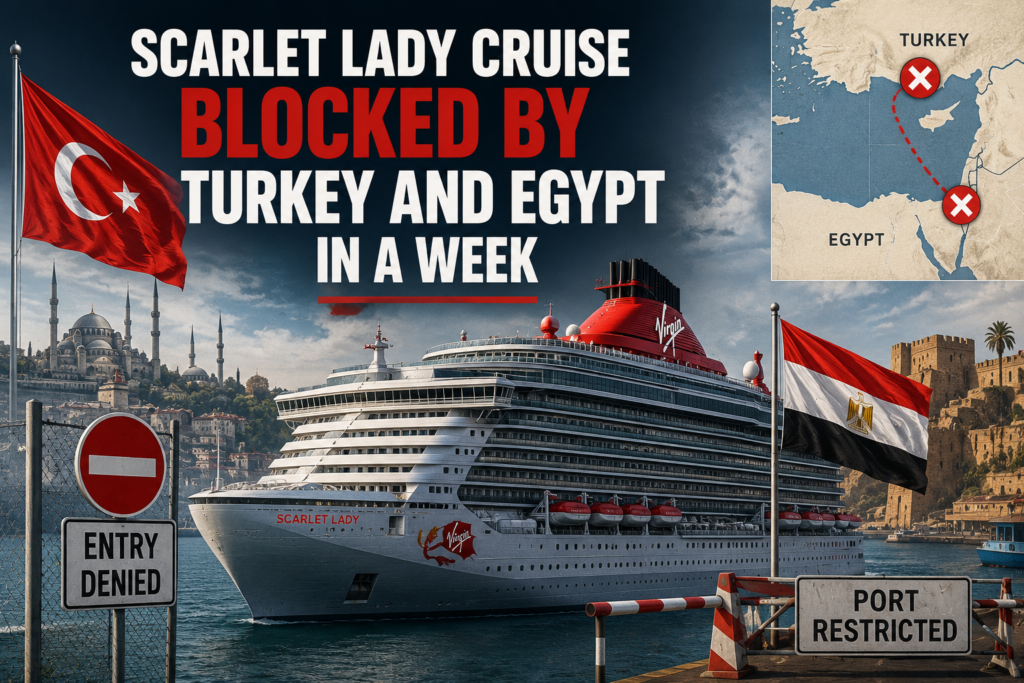
A Mediterranean cruise that was supposed to be about island-hopping, Broadway entertainment, and Greek sunsets became something else entirely this month: a geopolitical flashpoint. Virgin Voyages’ Scarlet Lady, chartered by veteran LGBTQ+ travel company Atlantis Events, was turned away from Turkish ports in early July 2026 — and then, just days later, blocked from docking in Egypt as well.
For a company that has run gay and lesbian cruise charters for 36 years, including more than a dozen previous visits to Turkey without incident, having two countries deny entry to the same voyage within one week is not a scheduling hiccup. It’s a first. This article walks through exactly what happened, in order, who has said what, and what it means for the roughly 1,900 to 2,000 passengers now finishing their trip in Greece, Montenegro, and Croatia instead.
What Happened: A Quick Overview
The short version: Scarlet Lady departed Athens on July 5, 2026, on a 10-night charter organized by Atlantis Events, bound for Venice (technically docking in nearby Trieste). The original itinerary included stops in Mykonos, Kuşadası and Istanbul in Turkey, Santorini, and destinations in Croatia. Days before arrival, Turkish authorities canceled both Turkish port calls. Atlantis scrambled to add a replacement stop in Alexandria, Egypt — only for Egyptian authorities to deny that call too, just hours before the ship was due to arrive. The voyage was rerouted a second time, this time to Chania in Crete and Kotor in Montenegro.
Background: Who Is Atlantis Events?
Atlantis Events was founded in the early 1990s by Rich Campbell, initially organizing all-gay resort vacations before expanding into full-ship cruise charters by the end of that decade. <cite index=”3-1″>The company does not own any ships of its own; instead, it charters vessels from major cruise lines, including Royal Caribbean International, Virgin Voyages, and Celebrity Cruises</cite>.
Turkey has historically been a reliable destination for the company. <cite index=”7-1″>Atlantis Events had operated 13 full-ship charters to Istanbul and other Turkish ports since 2000, carrying an estimated 25,000 guests over that period</cite>. That track record is part of why this month’s decision caught the company off guard.
Turkey Blocks the Scarlet Lady’s Port Calls
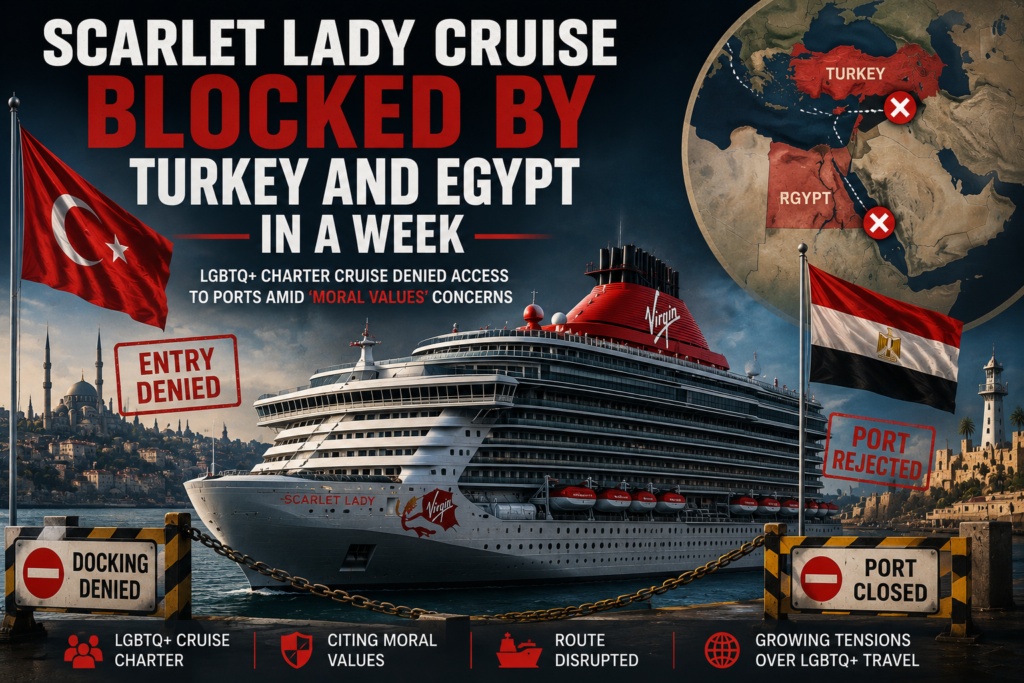
The trouble began before the ship even left port. <cite index=”8-1″>On June 28, before Scarlet Lady set sail, authorities in Turkey’s Aydın Province announced they would not allow the ship to dock at Kuşadası</cite>, a popular Aegean coastal town and gateway to the ancient ruins of Ephesus.
The province’s reasoning, delivered in a statement from the governor’s office and later confirmed through Turkish media, framed the objection in explicitly moral terms. <cite index=”16-1″>According to an English translation of the statement, officials said the ship had been chartered by groups “known for behavior inconsistent with our society’s structure and moral values.”</cite> The office added there was no possibility of allowing the group into the province for “an event of this nature.”
Istanbul followed with its own cancellation. <cite index=”7-1″>The controversy extended into the city when the Beyoğlu District Governor’s Office ordered the closure of Tek Yön, an LGBTQ+ venue that had posted a social media welcome to passengers from the cruise</cite>, even though the venue said it had not organized any special event tied to the ship.
Atlantis notified passengers of the cancellations on the day the news broke. <cite index=”14-1″>The company told guests that “due to circumstances beyond our control, we have had to change the ports in our itinerary to remove both port calls to Turkey”</cite>. In its place, the company initially added a full-day stop in Alexandria, Egypt, plus additional time in Crete.
Egypt Follows With a Second Denial
What happened next surprised even seasoned cruise-industry observers. <cite index=”1-1″>Just hours before the ship was scheduled to dock in Alexandria on July 9, passengers received a message through the Virgin Voyages onboard app informing them the ship had been “denied entry into Egyptian waters” and would no longer be able to call there</cite>.
<cite index=”11-1″>Cruise-tracking data showed the ship changing course in the early hours of July 9, while it was still less than 100 miles from Alexandria</cite>. Unlike Turkey, Egyptian officials offered no public justification for the decision. <cite index=”10-1″>Neither Egyptian officials, Virgin Voyages, nor Atlantis Events publicly explained why the Alexandria call was denied</cite>, and multiple outlets, including VV Insider, noted that the cause should be treated as unconfirmed absent an official statement.
Campbell addressed the surprise directly in a letter to passengers. <cite index=”3-1″>”We successfully sailed a similar itinerary last year without issue,” he wrote. “So we were surprised by this unfortunate decision.”</cite>
The ship was rerouted for a second time. <cite index=”17-1″>Instead of Alexandria, the itinerary was changed to add a call at Chania on Crete, while a previously planned stop in Heraklion was replaced with an additional sea day</cite>. <cite index=”10-1″>The remaining schedule kept Santorini and Chania in Greece, added Kotor in Montenegro, and preserved existing calls in Dubrovnik and Zadar, Croatia, before the ship’s scheduled arrival in Trieste, Italy, on July 15</cite>.
Practical fallout for guests was handled administratively rather than through refunds for the whole trip. <cite index=”17-1″>Guests who had booked shore excursions in Egypt through Virgin Voyages received automatic refunds, and a passport-control procedure that had been scheduled to take place in Alexandria was canceled</cite>.
How Passengers and Performers Reacted
Among the nearly 2,000 people on board was Broadway legend Patti LuPone, who was scheduled to perform for passengers during the voyage. <cite index=”2-1″>LuPone posted her reaction to the Turkey decision on Instagram, writing that a ship “full of gay men. And me” had been “denied entry to Turkey simply because of who is on board,” adding that she was “furious.”</cite>
Comedian Zach Noe Towers, also aboard the ship, posted a video reacting to news of the Egypt denial. <cite index=”10-1″>”It’s just blowing my mind,” he said, adding that the trip would still be fun, “in the face of adversity,” while questioning why passengers were considered “too gay” to spend money in the country</cite>.
Passenger sentiment, based on interviews and social media, leaned toward frustration with the countries involved rather than with the cruise operators. <cite index=”12-1″>One passenger, journalist Randy Slovacek, told a reporter that guests felt they’d “take our tourism dollars elsewhere,” adding that their “spirit isn’t broken”</cite>. Slovacek had sailed to Turkey with Atlantis before <cite index=”14-1”>and told CNN he’d never encountered a problem there previously, adding that the group was “just people who are just touring the world and trying to see everything we can.”</cite>
Coverage of onboard sentiment after the second reroute described a similarly resilient mood. <cite index=”12-1″>Reddit discussion among current and former Atlantis guests reflected disappointment with Turkey and Egypt’s decisions but placed no blame on Atlantis Events itself for the disruption</cite>.
Official and Industry Reactions
Rich Campbell has been the most consistent public voice throughout the episode, giving interviews to multiple major outlets. Speaking to CNN about the Turkey decision, he was blunt. <cite index=”2-1″>”It’s pretty stunning, to be honest,” Campbell said. “The reasoning behind it is that it’s a gay group.”</cite> He added that he found it concerning “when a country decides they can pick and choose which tourists are allowed in and which are not.”
<cite index=”13-1″>Campbell also noted that the company had made efforts involving the US Embassy to try to reverse Turkey’s decision, without success</cite>. He emphasized the historical significance of the episode: <cite index=”5-1″>in separate interviews, he said this marked the first time in Atlantis Events’ 36-year history that one of its cruises had been blocked “because of who we are.”</cite>
Other companies in the LGBTQ+ travel space weighed in as well. <cite index=”9-1″>A spokesperson for VACAYA, a competing LGBTQ+ cruise charter operator, told The Advocate that the company has “never been turned away from a port” and has called successfully at both Turkey and Egypt in the past</cite> — a comment that underscored how unusual this month’s decisions were, even within an industry accustomed to occasional political friction.
On the government side, only Turkey offered a public rationale, issued through the Aydın Governor’s Office as described above. <cite index=”4-1″>Officials also indicated the planned visit had generated “public concern” among local residents</cite>. No equivalent statement has been issued by Egyptian authorities, Egypt’s tourism ministry, or its foreign ministry. Reporters at multiple outlets, including The Advocate and CNN, said they had reached out to relevant government bodies, cruise operators, and the U.S. State Department for comment, with responses either pending or not received by the time of publication.
Why This Matters: Context on LGBTQ+ Rights in Turkey and Egypt
Neither country’s stance toward LGBTQ+ people emerged in isolation this month — both reflect years-long trends that help explain why this incident unfolded the way it did.
In Turkey, homosexuality itself is not illegal, but public life for LGBTQ+ people has grown steadily more restricted. <cite index=”14-1″>Authorities have banned Pride marches in Istanbul since 2015, citing public safety and security concerns, as rhetoric from President Recep Tayyip Erdoğan’s governing AK Party toward the LGBTQ+ community has hardened over the past decade</cite>. <cite index=”2-1″>Human rights groups raised alarms last year over leaked draft legislation that would criminalize same-sex commitment ceremonies and expand “public indecency” provisions</cite>.
Egypt’s legal and social environment is generally considered harsher still, even though its criminal code does not name homosexuality explicitly. Egyptian authorities have relied on broader public-morality statutes to target LGBTQ+ people in the past, a pattern independent legal and human rights observers have documented for years.
Impact on Passengers, Tourism, and Future Cruises
Beyond the immediate disruption to nearly 2,000 travelers’ vacations, the episode carries broader implications worth tracking.
For local economies in the affected port cities, the financial impact is straightforward and immediate. <cite index=”14-1″>Passenger Randy Slovacek noted that he felt for local vendors missing out on business because of the decision, adding that “Cairo and Crete will be enjoying our tourism dollars” instead</cite>.
For the cruise industry more broadly, some observers see a warning sign. <cite index=”15-1″>Kyle Olsen, owner of travel company Hermes Holidays, suggested that Egypt likely would not have barred the ship if Turkey hadn’t acted first, and warned that other countries could follow the same pattern going forward</cite>.
Whether the incident affects future bookings remains an open question. Virgin Voyages currently lists a separate 2027 Athens round-trip itinerary for Scarlet Lady that includes stops in Turkey and an overnight call in Alexandria, Egypt, as a gateway to Cairo excursions. It is too early to know whether this month’s denials will affect that future sailing or other planned Egypt and Turkey calls across the cruise industry, and readers should expect this detail to be updated as more information becomes available.
Timeline of Events
- June 28, 2026 — Authorities in Turkey’s Aydın Province announce, before the ship even departs, that Scarlet Lady will not be permitted to dock at Kuşadası.
- July 5, 2026 — Scarlet Lady departs Athens with roughly 1,900–2,000 passengers on a planned 10-night voyage to Trieste (Venice), with Turkish port calls already in question.
- Early July 2026 — Istanbul’s planned call is also canceled; the Beyoğlu District Governor’s Office orders the closure of an LGBTQ+ venue that had welcomed cruise passengers online.
- July 2–4, 2026 — Atlantis Events notifies passengers that both Turkish port calls have been removed from the itinerary; Alexandria, Egypt, and Crete, Greece, are added as replacements.
- July 7, 2026 — The ship’s originally scheduled Kuşadası call date passes with the port call already canceled.
- July 9, 2026 (early morning) — While less than 100 miles from Alexandria, Scarlet Lady is denied entry into Egyptian waters; passengers are notified via the Virgin Voyages app.
- July 9, 2026 — The itinerary is revised a second time, adding Chania (Crete) and Kotor (Montenegro), while keeping Dubrovnik and Zadar, Croatia.
- July 15, 2026 (scheduled) — Scarlet Lady is due to conclude the voyage in Trieste, Italy.
Key Facts
- Ship: Scarlet Lady, owned and operated by Virgin Voyages
- Charter operator: Atlantis Events, an LGBTQ+ travel company founded in the early 1990s
- Voyage: A 10-night charter from Athens, Greece, to Trieste (Venice), Italy
- Passengers: Approximately 1,900–2,000, including Broadway performer Patti LuPone
- Ports denied: Kuşadası and Istanbul, Turkey; Alexandria, Egypt
- Turkey’s stated reason: Incompatibility with local “moral values” and social structure, per the Aydın Governor’s Office
- Egypt’s stated reason: None publicly given as of publication
- Company history: First port denial “because of who we are” in Atlantis Events’ 36-year operating history, according to CEO Rich Campbell
Frequently Asked Questions
Why was the Scarlet Lady blocked from Turkey? Authorities in Turkey’s Aydın Province said the ship had been chartered by a group incompatible with the region’s social structure and moral values, and that the planned visit had raised public concern locally.
Why was the Scarlet Lady blocked from Egypt? Egyptian authorities have not issued a public explanation. Reports describe the decision as unconfirmed in its underlying cause, though it follows Turkey’s earlier denial by only a few days.
Is homosexuality illegal in Turkey or Egypt? Homosexuality is not explicitly illegal in either country. Turkey has increasingly restricted public LGBTQ+ events and expression in recent years, while Egypt has used broader public-morality and “debauchery” laws to target LGBTQ+ people in various contexts.
Where did the ship go instead? After the two denials, the voyage was rerouted to include stops in Chania (Crete), Greece; Kotor, Montenegro; and previously planned calls in Dubrovnik and Zadar, Croatia, before concluding in Trieste, Italy.
Has this happened to Atlantis Events before? No. CEO Rich Campbell said this marks the first time in the company’s 36-year history that one of its cruises has been denied port access specifically because of the identity of its passengers.
Did passengers get refunds? Guests who had booked shore excursions in Egypt through Virgin Voyages received automatic refunds for those bookings. There has been no report of broader compensation for the itinerary change as a whole.
Will this affect future Atlantis Events or Virgin Voyages cruises to Turkey or Egypt? It’s unclear. Virgin Voyages currently has a 2027 Scarlet Lady itinerary listed that includes both Turkey and an Alexandria, Egypt, stop, but whether this incident affects those future sailings has not yet been determined.
Conclusion
What began as a routine Mediterranean charter turned into a rare, back-to-back diplomatic snub — two countries, within days of each other, closing their ports to the same group of travelers. Turkey was explicit about its reasoning; Egypt has so far said nothing at all. For Atlantis Events, a company with decades of uneventful history in both countries, the episode marks new and uncomfortable territory. For the passengers aboard Scarlet Lady, it meant an unplanned but apparently good-humored detour through Crete and Montenegro instead. And for the broader cruise and tourism industry, it raises a question that will likely outlast this single voyage: whether other countries might follow the same pattern the next time an LGBTQ+ charter shows up on their port schedule.