
Introduction
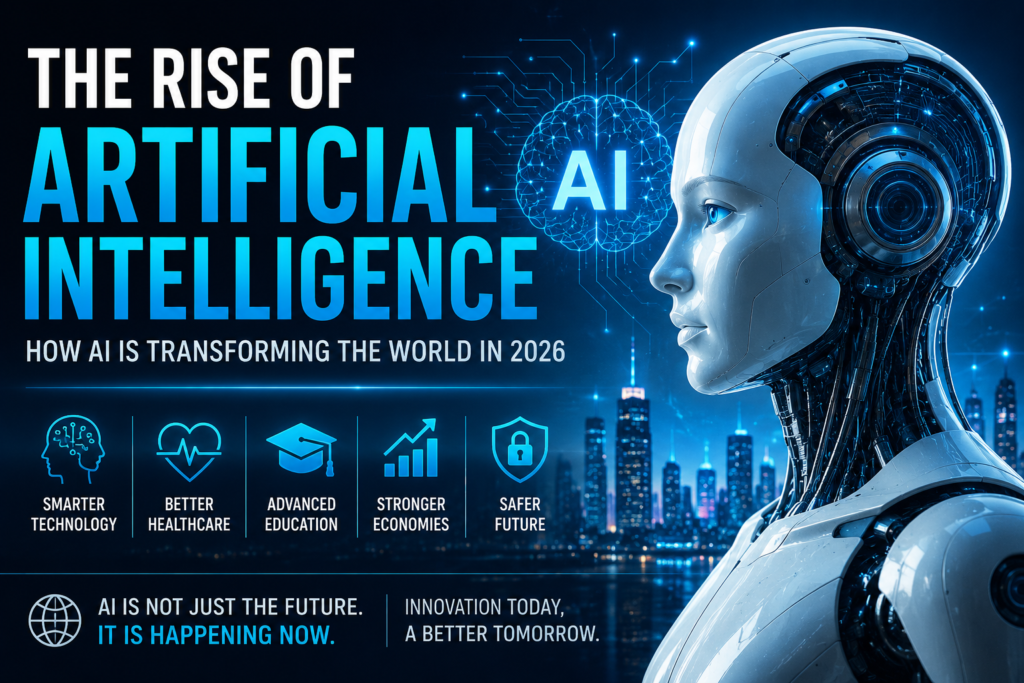
Artificial Intelligence (AI) is no longer a futuristic concept discussed only by scientists and technology experts. In 2026, AI has become one of the most influential technologies shaping economies, industries, governments, and everyday life.
From healthcare and education to finance and transportation, AI is transforming how people work, communicate, and solve complex problems. Major technology companies including OpenAI, Google, Microsoft, Meta, Apple, and Nvidia continue to invest billions of dollars into developing more advanced AI systems.
As AI capabilities rapidly improve, experts believe the technology could become as revolutionary as the internet itself.

What Is Artificial Intelligence?
Artificial Intelligence refers to computer systems designed to perform tasks that normally require human intelligence.
These tasks include:
- Understanding language
- Solving problems
- Learning from data
- Making decisions
- Generating content
- Recognizing images and speech
Modern AI systems can analyze vast amounts of information in seconds, allowing them to perform complex tasks with remarkable accuracy.
The recent growth of generative AI has accelerated global interest in the technology.
Why AI Is Growing So Fast
Several factors have contributed to AI’s rapid expansion.
Increased Computing Power
Modern processors and AI chips allow systems to process enormous amounts of data quickly.
Companies such as Nvidia have become central players in the AI revolution because their advanced chips power many AI models.
Massive Data Availability
AI systems learn from large datasets.
The growth of the internet, cloud computing, and digital services has provided unprecedented amounts of information for AI training.
Investment from Technology Giants
Technology companies continue investing heavily in AI research and development.
Billions of dollars are being spent to create more capable and efficient AI systems.
AI in Healthcare
Healthcare is among the industries benefiting most from artificial intelligence.
Hospitals and medical researchers now use AI to:
- Detect diseases earlier
- Analyze medical images
- Improve patient care
- Accelerate drug development
- Support medical research
AI-powered systems can identify patterns that might be difficult for humans to detect.
This helps doctors make more informed decisions and improve treatment outcomes.
AI in Education
Education is undergoing significant transformation through AI technology.
Students can now access personalized learning experiences tailored to their individual needs.
AI tools help:
- Generate study materials
- Explain difficult concepts
- Provide tutoring support
- Improve language learning
- Enhance research capabilities
Teachers also benefit from automated grading systems and educational analytics.
AI and the Future of Work
One of the most debated topics surrounding AI involves employment.
Some experts worry that automation could replace certain jobs.
Others argue that AI will create new opportunities and increase productivity.
Historically, technological revolutions have transformed labor markets rather than eliminating work entirely.
New careers related to AI development, data science, cybersecurity, and machine learning continue to emerge.
Workers who adapt to technological changes are likely to benefit most from the AI revolution.
AI in Business
Businesses worldwide are adopting AI to improve efficiency and competitiveness.
Organizations use AI for:
- Customer service
- Marketing
- Financial analysis
- Supply chain management
- Fraud detection
- Data analytics
AI helps companies reduce costs while improving customer experiences.
This explains why businesses across nearly every industry are investing in AI technologies.
AI and Cybersecurity
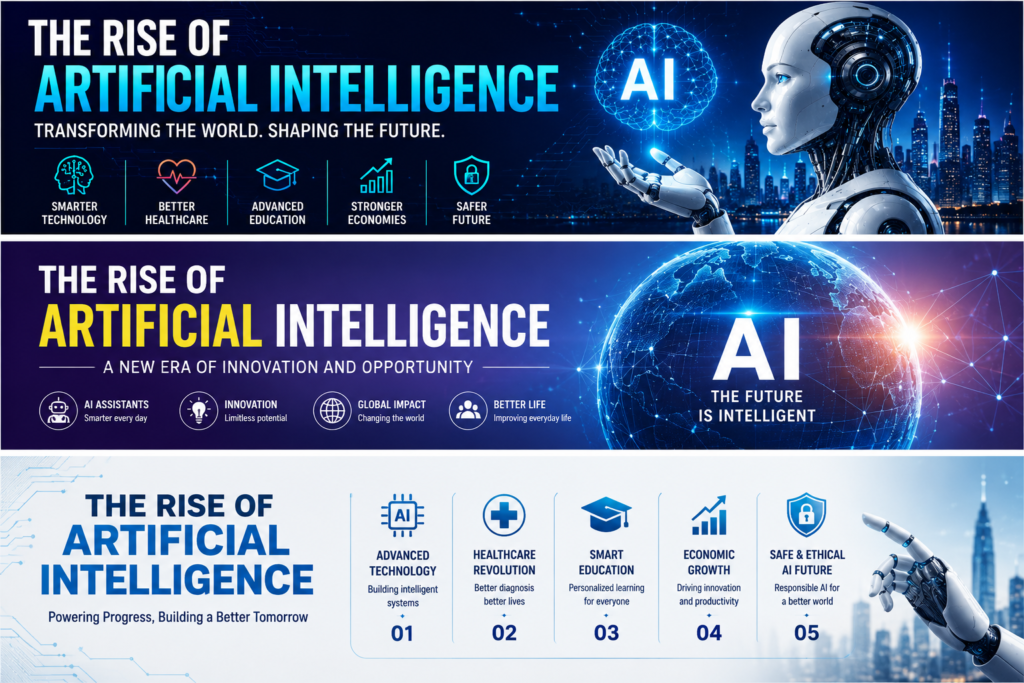
Artificial Intelligence plays an increasingly important role in cybersecurity.
Security teams use AI to:
- Detect cyber threats
- Identify suspicious activities
- Prevent fraud
- Analyze security risks
However, cybercriminals are also using AI to develop more sophisticated attacks.
This creates an ongoing technological race between defenders and attackers.
Experts believe cybersecurity will remain one of the most critical AI applications in the coming years.
The Rise of AI Assistants
AI assistants have become increasingly common in daily life.
Modern AI systems can:
- Answer questions
- Generate content
- Summarize information
- Assist with coding
- Provide recommendations
- Support business operations
These capabilities continue to improve as AI models become more advanced.
Many experts believe AI assistants will soon become standard workplace tools.
Challenges Facing AI
Despite its benefits, AI also presents significant challenges.
Privacy Concerns
AI systems often require access to large amounts of data.
This raises concerns about privacy and data protection.
Misinformation
Generative AI can create realistic images, videos, and text.
This increases concerns about misinformation and fake content.
Regulation
Governments worldwide are developing regulations to ensure responsible AI development.
Balancing innovation and safety remains a major challenge.
Ethical Questions
Questions regarding bias, transparency, accountability, and decision-making continue to generate debate among experts.
The Global AI Race
Countries around the world are competing to become leaders in artificial intelligence.
The United States, China, European nations, and several Middle Eastern countries have launched major AI initiatives.
Governments view AI as a strategic technology capable of influencing economic growth, national security, and technological leadership.
The competition for AI leadership is expected to intensify throughout the coming decade.
What the Future Holds
Experts predict that AI will continue expanding into every aspect of society.
Future developments may include:
- More advanced virtual assistants
- Autonomous transportation systems
- Smarter healthcare technologies
- Personalized education platforms
- Improved scientific research
- Enhanced business automation
While challenges remain, few technologies have generated as much excitement and investment as artificial intelligence.
Conclusion
Artificial Intelligence is transforming the world at an unprecedented pace. From healthcare and education to business and cybersecurity, AI is reshaping industries and creating new opportunities.
As governments, businesses, and individuals adapt to this technological revolution, AI will likely remain one of the most important developments of the 21st century.
The coming years may determine how humanity harnesses AI’s potential while addressing the risks and challenges that accompany such powerful technology.